GitHub API Enumeration, Grok Build CLI Data Exposure, AWS Security Hub Network Scanning, AI-Powered Patch Pressure, and Why Visibility Is Not Ownership
Try reloading the player or open this episode directly on YouTube.
This episode of Ship It Weekly explores GitHub API enumeration, data exposure from AI tools, and AWS Security Hub's new features.
Now Playing
GitHub API Enumeration, Grok Build CLI Data Exposure, AWS Security Hub Network Scanning, AI-Powered Patch Pressure, and Why Visibility Is Not Ownership
Ship It Weekly
0:0019:16
Chapters
Jump to a section in this episode.
Speed & share
Transcript
This week, Datadog is tracking coordinated GitHub
API enumeration using ghost accounts, leaked
tokens, and normal-looking API traffic, which
is a reminder that public metadata can still
become operational intelligence. xAI's Grok Build
CLI reportedly transmitted repository data without
redaction. So the AI coding tool question is
not just, does it help me build faster? It
is, what did it read? And where did that data
go? AWS Security Hub added Network Scanning and
exposure impact analysis, which gets cloud security
closer to the attacker's view. What is actually
reachable? And what can that reachable thing
access next? And Microsoft says AI-powered vulnerability
discovery is changing patch management. More
bugs found faster means more pressure on the
teams that have to test, deploy, and recover
from patches. Put those together, and the theme
this week is exposure. Who can map your systems?
Who can read your code? Who can reach your infrastructure?
And who owns the response when the map gets too
accurate? I'm Brian Teller from Teller's Tech,
and this is Ship It Weekly. Welcome back to Ship
It Weekly, the show about the DevOps, SRE, cloud,
platform, and security stories that actually
matter when you are the person who has to keep
the thing running at 3am. If you are new here,
follow or subscribe wherever you are watching
or listening. And if you want the weekly story
list and source links, check out OnCallBrief
.com. For past episodes, full show notes, and
more from the show, head over to ShipItWeekly
.fm. This week, we start with GitHub API enumeration
because attackers do not always need an exploit
to build a useful map of your organization. Then
we get into Grok Build CLI and the data boundary
around AI coding tools. After that, AWS Security
Hub Network Scanning and impact analysis. Then
Microsoft's warning that AI-powered vulnerability
discovery may mean more patches, faster timelines,
and less room for slow change management. In
the lightning round, HalluSquatting, Cloudflare
control plane incidents, node-tar CVEs, ServiceNow
Not the loud kind. Not always a breach. Not always an exploit. Not always some dramatic chain of events where one vulnerability turns into full compromise in five minutes.
Sometimes exposure is quieter than that.
A GitHub API response. A public repo name. An old token. A CLI tool reading more files than you expected. A cloud resource that is reachable even though the diagram says it should not be. A patch backlog that looks fine until the discovery rate changes.
That is the uncomfortable part. Exposure often starts as visibility. And visibility can feel harmless.
The repo is public anyway. The API only returned metadata. The tool only read files on my laptop. The port was only open for testing. The patch is on the list. The postmortem is documented.
All of that sounds reasonable in isolation. But attackers do not need your systems to be obviously broken. They need enough of a map to make better decisions than you think they can make.
That is why the Datadog GitHub API enumeration story matters.
It is not a classic zero-day story. It is not someone popping shells through a wild exploit chain. It is API traffic. Questions asked through interfaces that are supposed to answer questions.
Who belongs to this org? What repos are visible? What naming patterns exist? What project names leak through public references? Which users are active? Which private repo paths might exist? What OAuth tokens or personal access tokens are worth abusing?
Individually, a lot of that can look boring. At scale, it becomes reconnaissance. And recon is not harmless just because the first layer of data is public.
Public metadata reduces uncertainty. It tells an attacker where to look next. It helps them write better phishing messages. It helps them identify teams, repos, naming conventions, internal systems, release patterns, and likely owners. It turns “we know nothing” into “we know enough to keep going.”
The ghost account part makes that even more interesting.
A brand-new account firing API requests at a bunch of organizations is suspicious. An older account that has existed for years feels different. It has age. It has history. It blends into the noise better. And if the traffic uses normal-looking user agents or analytics-style names, the whole thing can look less like an attack and more like background internet weather.
That is the hard operational problem. Not every bad thing looks bad at the point where you could still stop it easily. By the time enumeration turns into private repo access, token abuse, or cloning, the quiet phase already did its job.
So the practical takeaway is pretty simple. GitHub is not just source control. It is a production surface.
It holds code. It holds workflow logic. It holds release paths. It holds references to infrastructure. It holds build instructions. It holds internal names. It often holds too much history. And it sits close to secrets, cloud roles, registries, package publishing, deploy automation, and developer identities.
That means GitHub API activity matters. Token scopes matter. OAuth apps matter. Old PATs matter. Outside collaborators matter. Dormant users matter. Audit logs matter. GraphQL usage patterns matter. Private repo path probes matter.
Because the repo platform is part of the system now. Not adjacent to it. Part of it.
The Grok Build CLI story comes at exposure from a different direction.
This one is about AI coding tools and the data boundary around them. And honestly, this is where a lot of teams are behind. Because many organizations still think of coding assistants like editor features. Like autocomplete got smarter. Like a plugin got more helpful.
But some of these tools are not just suggesting text. They read files. They inspect repos. They look at environment files. They summarize docs. They understand build systems. They run commands. They install packages. They connect to cloud services. They send context somewhere else for processing.
That is not just an editor feature. That is access.
If a tool reads your .env file, that is access. If it reads Terraform, Helm charts, Kubernetes manifests, GitHub Actions workflows, runbooks, incident notes, or internal docs, that is access. If it sends that context to a hosted service, that is data movement.
And once data moves, the questions change.
Where did it go? Was it retained? Was it used for training? Can admins control it? Can the org audit it? Does it respect ignored files? Does it read Git history? Does it upload the whole repo or selected context? Can engineers use it in production repos? Can they use it in customer code? Can they use it in security repos? Can they use it in infra repos?
Those questions can sound like procurement paperwork. They are not. They are production security questions.
Repos are not just code anymore. They are architecture. They are service names. They are IAM assumptions. They are deployment rules. They are CI/CD logic. They are incident history. They are internal conventions. Sometimes they are secrets. And increasingly, they are instructions for agents.
That makes repo context sensitive even when the source code itself is not some secret algorithm.
This is why “it was just on my laptop” does not work as a boundary. A laptop can be the place where source code, credentials, cloud sessions, dev tooling, observability access, and AI tools all meet. That is a lot of trust in one place.
So the point is not “never use AI coding tools.” That is not realistic. The point is to stop pretending they are harmless by default.
They need policy. They need approved usage. They need repo boundaries. They need secret handling. They need enterprise controls. They need auditability. And engineers need to know what is okay and what is not.
Because if an AI tool can read part of your system, it is now part of your system.
That same idea shows up in the AWS Security Hub story.
Security Hub Network Scanning and exposure impact analysis are interesting because they move closer to reality. Not just “based on config, this might be exposed.” More like “we checked from the outside, this is reachable.”
That matters because cloud environments drift. Everyone who has worked around AWS long enough has seen some version of this.
A public IP attached during troubleshooting. A port opened temporarily and never closed. A test load balancer that outlived the test. A Kubernetes service copied from dev and accidentally made public. A security group that looks fine in one view but behaves differently when all the networking pieces come together. A resource no one remembers owning.
Config analysis is useful. But the internet does not care what your diagram intended. The internet cares whether it can reach the thing.
That is why active scanning matters. Can I reach it? What port is open? What service is there? What evidence proves it? That is closer to how an attacker thinks.
But reachability is still only half the story. The blast radius matters too.
An exposed test machine with no useful permissions is one kind of problem. An exposed instance with an IAM role that can read production secrets, write to S3, reach a database, or assume another role is a very different problem. Same open port. Very different incident.
That is where impact analysis gets useful. The exposed resource is the front door. The permissions behind it decide how bad the house fire can get.
So prioritization should not only be severity labels. It should be reachability plus blast radius.
Public and reachable matters. Public and reachable with dangerous IAM matters more. Public and reachable with a path to sensitive downstream systems matters a lot.
And when something is exposed, closing the port is not the whole fix. It is the first fix.
The better questions come after. Who owns this? Why did it exist? How long was it exposed? What could it access? Did anything touch it? What logs prove that? What guardrail prevents it from coming back?
That is the difference between closing a finding and improving the system. One clears the dashboard. The other reduces future risk.
The Microsoft story takes the same exposure theme and applies it to time.
AI-powered vulnerability discovery changes the tempo. That is the part operators need to care about. Not because everyone suddenly needs to become a Windows expert. Because the larger pattern applies everywhere.
AI helps write code faster. It helps analyze code faster. It helps defenders find bugs faster. And eventually, attackers get better at finding useful paths faster too.
Microsoft is basically saying the discovery side is accelerating. More issues found. More validation. More high-confidence findings reaching engineers. More security updates.
That creates pressure on the people who have to patch real systems.
And patching is not free. Patches break things. Drivers break things. Agents break things. Middleware breaks things. Security fixes have side effects. Anyone who has owned production systems knows this.
So the answer cannot be “patch everything instantly and hope.” But the answer also cannot be slow spreadsheet theater forever.
A lot of patch management still depends on manual coordination. Someone exports a report. Someone ranks CVEs. Someone emails owners. Someone asks for exceptions. Someone waits for a maintenance window. Someone says the app team is not comfortable yet. Someone updates the spreadsheet. Then everyone hopes the numbers are real.
That process already struggles. If the volume and speed of vulnerability discovery keeps increasing, that process gets worse.
So patching has to look more like production operations. Know what you own. Roll out in stages. Measure failures. Have rollback paths. Know coverage. Know exceptions. Have an emergency lane. And be able to explain the difference between “we patched” and “we think we patched.”
That is the platform angle. Patch management is not just a security team problem. It is operational infrastructure. It needs the same kind of thinking we apply to deploys, rollbacks, SLOs, automation, and incident response.
Security updates are becoming production operations. So the process around them needs to grow up.
The lightning round keeps circling the same theme.
HalluSquatting is exposure through generated assumptions. If an AI agent invents a package name and an attacker registers that name, the model’s hallucination becomes a dependency risk. That is wild, but it is also kind of obvious once you see it. Do not let agents install packages just because the name sounds real.
Cloudflare dashboard and API incidents are exposure through control-plane dependency. The edge can still be serving traffic, but if the dashboard or API is unavailable, your ability to respond may be limited. Data plane and control plane are different. Both need to be part of your reliability model.
node-tar CVEs are exposure through boring input handling. Archive parsing sits in package managers, build systems, CI jobs, artifact pipelines, upload services, backups, and scanners. If you process untrusted archives, tar parsing bugs matter.
ServiceNow authentication risk is exposure through enterprise workflow platforms. A single unauthenticated endpoint in a system full of tickets, assets, incidents, employee data, workflows, and operational context is not a small thing. It is an enterprise visibility problem.
France pushing quantum risk into procurement language is exposure through time. Data that needs to stay secret for years has different risk. Post-quantum migration becomes real through procurement, compliance, vendor questionnaires, and data retention expectations before it becomes real in the backlog.
And Lambda Managed Instances for Java cold starts are a reminder that abstractions still have mechanics underneath. Serverless can hide servers. It cannot hide physics. Cold starts, warm capacity, runtime behavior, and cost still matter.
That is why the human closer lands on maps.
This episode is full of maps. GitHub maps. Repo data maps. Internet exposure maps. IAM blast-radius maps. Patch coverage maps. Incident timelines. Postmortem documents. Approval flows.
Maps are useful. I like maps. I want better maps.
But a map is not a fix.
An exposure finding does not close the port. An API log does not revoke the token. A patch bulletin does not patch the fleet. A postmortem timeline does not create learning. A human approval step does not guarantee judgment if the human has no context.
That last one is especially important right now.
A lot of systems add a human-in-the-loop step because it sounds safe. And sometimes it is. But not automatically.
If the human is pulled in at the worst moment, with the least context, under the most pressure, the approval step can become theater. They are technically in the loop. But they do not really have the time, context, or authority to make the system safer.
Post-incident reviews can fall into the same trap.
A meeting is not learning. A timeline is not learning. A document in the wiki is not learning. Those things can help. But learning happens when the system changes.
Ownership becomes clearer. The runbook improves. Alert noise goes down. A risky default gets removed. A manual step gets automated. A guardrail gets added. The next operator is less dependent on luck.
So the useful question is not just, “did we review the incident?” The useful question is, “what changed because of it?”
That applies to every story this week. If GitHub API traffic can map your org, what changed? If an AI tool can read your repo, what changed? If Security Hub finds something exposed, what changed? If patch pressure is going up, what changed? If a human approval step is mostly theater, what changed?
Visibility is good. Maps are good. Scanners are good. Dashboards are good. Postmortems are good. But none of them are ownership by themselves.
Exposure only becomes safer when someone uses the map to change the system.
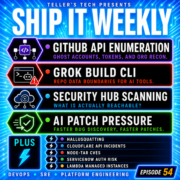
This week on Ship It Weekly: Datadog tracked coordinated GitHub API enumeration, xAI’s Grok Build CLI reportedly uploaded repo data without redaction, AWS Security Hub added Network Scanning and exposure impact analysis, and Microsoft says AI-powered vulnerability discovery is changing patch pressure.
The theme: visibility is not ownership. A GitHub API map does not revoke a token. An exposure finding does not close a port. A patch bulletin does not patch the fleet. And an AI coding tool reading your repo is still access.
Brian covers GitHub as a production surface, AI coding tool data boundaries, cloud exposure based on reachability and blast radius, and why patching needs to look more like production operations than spreadsheet theater.
Also, the Ship It Weekly shop is open at shop.tellerstech.com with Ship It Weekly t-shirt designs. Use coupon code SHIPTHESTORE for 20% off your order for the next few weeks.


This episode is about exposure.
Not the loud kind. Not always a breach. Not always an exploit. Not always some dramatic chain of events where one vulnerability turns into full compromise in five minutes.
Sometimes exposure is quieter than that.
A GitHub API response. A public repo name. An old token. A CLI tool reading more files than you expected. A cloud resource that is reachable even though the diagram says it should not be. A patch backlog that looks fine until the discovery rate changes.
That is the uncomfortable part. Exposure often starts as visibility. And visibility can feel harmless.
The repo is public anyway. The API only returned metadata. The tool only read files on my laptop. The port was only open for testing. The patch is on the list. The postmortem is documented.
All of that sounds reasonable in isolation. But attackers do not need your systems to be obviously broken. They need enough of a map to make better decisions than you think they can make.
That is why the Datadog GitHub API enumeration story matters.
It is not a classic zero-day story. It is not someone popping shells through a wild exploit chain. It is API traffic. Questions asked through interfaces that are supposed to answer questions.
Who belongs to this org? What repos are visible? What naming patterns exist? What project names leak through public references? Which users are active? Which private repo paths might exist? What OAuth tokens or personal access tokens are worth abusing?
Individually, a lot of that can look boring. At scale, it becomes reconnaissance. And recon is not harmless just because the first layer of data is public.
Public metadata reduces uncertainty. It tells an attacker where to look next. It helps them write better phishing messages. It helps them identify teams, repos, naming conventions, internal systems, release patterns, and likely owners. It turns “we know nothing” into “we know enough to keep going.”
The ghost account part makes that even more interesting.
A brand-new account firing API requests at a bunch of organizations is suspicious. An older account that has existed for years feels different. It has age. It has history. It blends into the noise better. And if the traffic uses normal-looking user agents or analytics-style names, the whole thing can look less like an attack and more like background internet weather.
That is the hard operational problem. Not every bad thing looks bad at the point where you could still stop it easily. By the time enumeration turns into private repo access, token abuse, or cloning, the quiet phase already did its job.
So the practical takeaway is pretty simple. GitHub is not just source control. It is a production surface.
It holds code. It holds workflow logic. It holds release paths. It holds references to infrastructure. It holds build instructions. It holds internal names. It often holds too much history. And it sits close to secrets, cloud roles, registries, package publishing, deploy automation, and developer identities.
That means GitHub API activity matters. Token scopes matter. OAuth apps matter. Old PATs matter. Outside collaborators matter. Dormant users matter. Audit logs matter. GraphQL usage patterns matter. Private repo path probes matter.
Because the repo platform is part of the system now. Not adjacent to it. Part of it.
The Grok Build CLI story comes at exposure from a different direction.
This one is about AI coding tools and the data boundary around them. And honestly, this is where a lot of teams are behind. Because many organizations still think of coding assistants like editor features. Like autocomplete got smarter. Like a plugin got more helpful.
But some of these tools are not just suggesting text. They read files. They inspect repos. They look at environment files. They summarize docs. They understand build systems. They run commands. They install packages. They connect to cloud services. They send context somewhere else for processing.
That is not just an editor feature. That is access.
If a tool reads your
.envfile, that is access. If it reads Terraform, Helm charts, Kubernetes manifests, GitHub Actions workflows, runbooks, incident notes, or internal docs, that is access. If it sends that context to a hosted service, that is data movement.And once data moves, the questions change.
Where did it go? Was it retained? Was it used for training? Can admins control it? Can the org audit it? Does it respect ignored files? Does it read Git history? Does it upload the whole repo or selected context? Can engineers use it in production repos? Can they use it in customer code? Can they use it in security repos? Can they use it in infra repos?
Those questions can sound like procurement paperwork. They are not. They are production security questions.
Repos are not just code anymore. They are architecture. They are service names. They are IAM assumptions. They are deployment rules. They are CI/CD logic. They are incident history. They are internal conventions. Sometimes they are secrets. And increasingly, they are instructions for agents.
That makes repo context sensitive even when the source code itself is not some secret algorithm.
This is why “it was just on my laptop” does not work as a boundary. A laptop can be the place where source code, credentials, cloud sessions, dev tooling, observability access, and AI tools all meet. That is a lot of trust in one place.
So the point is not “never use AI coding tools.” That is not realistic. The point is to stop pretending they are harmless by default.
They need policy. They need approved usage. They need repo boundaries. They need secret handling. They need enterprise controls. They need auditability. And engineers need to know what is okay and what is not.
Because if an AI tool can read part of your system, it is now part of your system.
That same idea shows up in the AWS Security Hub story.
Security Hub Network Scanning and exposure impact analysis are interesting because they move closer to reality. Not just “based on config, this might be exposed.” More like “we checked from the outside, this is reachable.”
That matters because cloud environments drift. Everyone who has worked around AWS long enough has seen some version of this.
A public IP attached during troubleshooting. A port opened temporarily and never closed. A test load balancer that outlived the test. A Kubernetes service copied from dev and accidentally made public. A security group that looks fine in one view but behaves differently when all the networking pieces come together. A resource no one remembers owning.
Config analysis is useful. But the internet does not care what your diagram intended. The internet cares whether it can reach the thing.
That is why active scanning matters. Can I reach it? What port is open? What service is there? What evidence proves it? That is closer to how an attacker thinks.
But reachability is still only half the story. The blast radius matters too.
An exposed test machine with no useful permissions is one kind of problem. An exposed instance with an IAM role that can read production secrets, write to S3, reach a database, or assume another role is a very different problem. Same open port. Very different incident.
That is where impact analysis gets useful. The exposed resource is the front door. The permissions behind it decide how bad the house fire can get.
So prioritization should not only be severity labels. It should be reachability plus blast radius.
Public and reachable matters. Public and reachable with dangerous IAM matters more. Public and reachable with a path to sensitive downstream systems matters a lot.
And when something is exposed, closing the port is not the whole fix. It is the first fix.
The better questions come after. Who owns this? Why did it exist? How long was it exposed? What could it access? Did anything touch it? What logs prove that? What guardrail prevents it from coming back?
That is the difference between closing a finding and improving the system. One clears the dashboard. The other reduces future risk.
The Microsoft story takes the same exposure theme and applies it to time.
AI-powered vulnerability discovery changes the tempo. That is the part operators need to care about. Not because everyone suddenly needs to become a Windows expert. Because the larger pattern applies everywhere.
AI helps write code faster. It helps analyze code faster. It helps defenders find bugs faster. And eventually, attackers get better at finding useful paths faster too.
Microsoft is basically saying the discovery side is accelerating. More issues found. More validation. More high-confidence findings reaching engineers. More security updates.
That creates pressure on the people who have to patch real systems.
And patching is not free. Patches break things. Drivers break things. Agents break things. Middleware breaks things. Security fixes have side effects. Anyone who has owned production systems knows this.
So the answer cannot be “patch everything instantly and hope.” But the answer also cannot be slow spreadsheet theater forever.
A lot of patch management still depends on manual coordination. Someone exports a report. Someone ranks CVEs. Someone emails owners. Someone asks for exceptions. Someone waits for a maintenance window. Someone says the app team is not comfortable yet. Someone updates the spreadsheet. Then everyone hopes the numbers are real.
That process already struggles. If the volume and speed of vulnerability discovery keeps increasing, that process gets worse.
So patching has to look more like production operations. Know what you own. Roll out in stages. Measure failures. Have rollback paths. Know coverage. Know exceptions. Have an emergency lane. And be able to explain the difference between “we patched” and “we think we patched.”
That is the platform angle. Patch management is not just a security team problem. It is operational infrastructure. It needs the same kind of thinking we apply to deploys, rollbacks, SLOs, automation, and incident response.
Security updates are becoming production operations. So the process around them needs to grow up.
The lightning round keeps circling the same theme.
HalluSquatting is exposure through generated assumptions. If an AI agent invents a package name and an attacker registers that name, the model’s hallucination becomes a dependency risk. That is wild, but it is also kind of obvious once you see it. Do not let agents install packages just because the name sounds real.
Cloudflare dashboard and API incidents are exposure through control-plane dependency. The edge can still be serving traffic, but if the dashboard or API is unavailable, your ability to respond may be limited. Data plane and control plane are different. Both need to be part of your reliability model.
node-tar CVEs are exposure through boring input handling. Archive parsing sits in package managers, build systems, CI jobs, artifact pipelines, upload services, backups, and scanners. If you process untrusted archives, tar parsing bugs matter.
ServiceNow authentication risk is exposure through enterprise workflow platforms. A single unauthenticated endpoint in a system full of tickets, assets, incidents, employee data, workflows, and operational context is not a small thing. It is an enterprise visibility problem.
France pushing quantum risk into procurement language is exposure through time. Data that needs to stay secret for years has different risk. Post-quantum migration becomes real through procurement, compliance, vendor questionnaires, and data retention expectations before it becomes real in the backlog.
And Lambda Managed Instances for Java cold starts are a reminder that abstractions still have mechanics underneath. Serverless can hide servers. It cannot hide physics. Cold starts, warm capacity, runtime behavior, and cost still matter.
That is why the human closer lands on maps.
This episode is full of maps. GitHub maps. Repo data maps. Internet exposure maps. IAM blast-radius maps. Patch coverage maps. Incident timelines. Postmortem documents. Approval flows.
Maps are useful. I like maps. I want better maps.
But a map is not a fix.
An exposure finding does not close the port. An API log does not revoke the token. A patch bulletin does not patch the fleet. A postmortem timeline does not create learning. A human approval step does not guarantee judgment if the human has no context.
That last one is especially important right now.
A lot of systems add a human-in-the-loop step because it sounds safe. And sometimes it is. But not automatically.
If the human is pulled in at the worst moment, with the least context, under the most pressure, the approval step can become theater. They are technically in the loop. But they do not really have the time, context, or authority to make the system safer.
Post-incident reviews can fall into the same trap.
A meeting is not learning. A timeline is not learning. A document in the wiki is not learning. Those things can help. But learning happens when the system changes.
Ownership becomes clearer. The runbook improves. Alert noise goes down. A risky default gets removed. A manual step gets automated. A guardrail gets added. The next operator is less dependent on luck.
So the useful question is not just, “did we review the incident?” The useful question is, “what changed because of it?”
That applies to every story this week. If GitHub API traffic can map your org, what changed? If an AI tool can read your repo, what changed? If Security Hub finds something exposed, what changed? If patch pressure is going up, what changed? If a human approval step is mostly theater, what changed?
Visibility is good. Maps are good. Scanners are good. Dashboards are good. Postmortems are good. But none of them are ownership by themselves.
Exposure only becomes safer when someone uses the map to change the system.
That is the work.
Visibility is not ownership.
A map is not a fix.
Extra links worth including:
Datadog: Coordinated GitHub API enumeration
https://securitylabs.datadoghq.com/articles/coordinated-github-api-enumeration/
The Verge: Grok Build CLI repository upload report
https://www.theverge.com/ai-artificial-intelligence/965600/spacexai-grok-build-repository-upload
AWS Security Hub Network Scanning
https://aws.amazon.com/about-aws/whats-new/2026/07/aws-security-hub-network-scanning/
AWS Security Hub impact analysis for exposure findings
https://aws.amazon.com/about-aws/whats-new/2026/07/impact-analysis-aws-security-hub/
Microsoft: Windows vulnerability management and AI-powered discovery
https://blogs.windows.com/windowsexperience/2026/07/09/evolving-windows-vulnerability-management-to-meet-the-speed-of-ai-powered-discovery/
SRE Weekly Issue 525
https://sreweekly.com/sre-weekly-issue-525/
HalluSquatting / hallucinated package risk
https://www.endorlabs.com/learn/slopsquatting-when-ai-agents-hallucinate-malicious-packages
AWS Lambda Managed Instances for Java cold starts
https://aws.amazon.com/blogs/compute/eliminating-java-cold-starts-with-aws-lambda-managed-instances/
This week’s On Call Brief
https://www.tellerstech.com/on-call-brief-news/2026-W29/
Ship It Weekly shop
https://shop.tellerstech.com/
More Ship It Weekly episodes
https://shipitweekly.fm/