Try reloading the player or open this episode directly on YouTube.
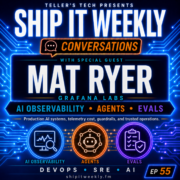
In this episode, Mat Ryer from Grafana Labs discusses AI observability, focusing on the transition from demos to production systems. He explores the challenges of measuring AI's effectiveness, the importance of telemetry, and the need for trust in AI outputs.
Now Playing
Ship It Conversations: Mat Ryer of Grafana Labs on AI Observability, Agents, Evals, and Operating AI in Production
Ship It Weekly
0:0045:06
Chapters
Jump to a section in this episode.
Speed & share
Transcript
AI demos are easy. That is kind of the problem.
You can wire an LLM into a tool, give it a few
prompts, let it call an API, and suddenly it
looks like magic. It writes queries, it explains
dashboards, it investigates issues. It might
even suggest a fix. And in a demo, that feels
great. But production does not care about demos.
Production cares if the answer was right. If the
agent used the right tool. If it leaked data. If
it got confused by logs. If it made things worse
after a deploy. If the cost graph quietly turned
into a crime scene. And that is where this gets
interesting because the hard part is not proving
AI can do something impressive in a controlled
demo. The hard part is figuring out what happens
after people start depending on it. When it is
connected to real tools, real telemetry, real
production systems, real costs, real failure
modes, at that point, AI is not just a feature
anymore. It is another thing you have to operate.
I'm Brian Teller from Teller's Tech, and this
is Ship It Weekly. Welcome back to Ship It Weekly,
where I filter the noise and focus on what actually
matters when you are the one running infrastructure
and owning reliability. Most weeks, it's a quick
DevOps, SRE, platform, cloud, and security news
recap. In between those, I do conversation episodes
with people building and operating the systems we
all end up depending on. Today, I'm joined by
Mat Ryer from Grafana Labs. Mat is Senior
Director of AI at Grafana, a longtime Go developer,
author, open source contributor, and podcast
host. And in this episode, we talk about what
happens when AI moves out of the demo booth and
into production. We get into Grafana Assistant,
AI observability, evals, LLM-as-judge patterns,
telemetry cost, OpenTelemetry, agent guardrails
and why a chat interface is not enough if the
system underneath is making decisions people
need to trust one of the threads i liked most
in this conversation is Mat's point that AI
gives us a new primitive that sounds big and
abstract but his example is pretty simple a conversation
plus a loop suddenly becomes an agent Or as Mat
put it, for loops are back. But once people rely
on that agent, the problem changes. Now you need
to know whether it helped, whether it answered
the question, whether it picked the right tools,
whether a prompt change improved one workflow
while breaking another, whether your AI feature
is actually observable enough to operate like
the rest of your production stack. We also talk
about why AI observability is not just latency,
logs, and HTTP 200s. Those still matter, obviously.
But now you also care about behavior, cost, tool
selection, user feedback, eval results, model
versions, prompt changes, and whether the agent
is producing something useful. or just confidently
wandering around your telemetry matt also gets
into UX which i think is more important here
than people give it credit for because if the
AI gives you a wall of text you still have to
trust that text but if it can show you the graph
deep link you into the right Grafana view apply
the filters and let you inspect the source data
yourself that is a very different experience
and near the end We talk about where AI can actually
help operations teams today, not some giant six
-month AI transformation project. More like pick
something small. Use it to enhance the workflows
you already have. Let it write the query. Let
it help with the first pass. Let it automate
the boring parts, but build the guardrails and
feedback loops around it, which honestly fits
the name of the show pretty well. Ship something
small. learn from it, then ship again. All right,
let's jump in. Today, I'm joined by Mat Ryer
from Grafana Labs. Mat is a senior director
of AI at Grafana, where he's focused on how AI
fits into observability and production systems.
He's also a longtime Go developer, author, open
source contributor, and podcast host. And we're
talking about what happens when AI moves from
demos into production, why observability for
AI systems is not the same as basic service monitoring,
and what teams should be thinking about as telemetry
volume, cost, and operational complexity keep
climbing. Mat, thank you for joining me. Thank
you, Brian. Pleasure to be here. So starting
out, I'm curious, as AI systems move from experiments
into production, What are teams underestimating?
Yes. Well, first of all, I think it's very exciting,
this whole space. And I think that's where I
always start with this. We have a new primitive
now. We have a new capability, something that
we couldn't do before. And that, I think, is
just a very exciting thing. There are concerns
with AI and valid concerns. alongside them are
i think is the fact that we are now in a new
world and this is a very exciting thing you see
people making little agents to solve all kinds
of little problems we see people building big
agents and big complex ones as we are doing as
well at Grafana Labs to solve more complex and
deeper problems and just now like having a a
new primitive like a conversation Being able
to now, even just putting that in a loop, by
the way, which was when things became agentic.
That's just a for loop. That's just like, oh,
for loops are back. They're so back. They're
cool again. And I think agents are just amazing.
Just a simple primitive put together with something
that we're already very familiar with can produce
something new. So we're still in that phase.
And I love to see all the little things that
people are building. At some point you do end
up with, like we have a product in production,
Grafana Assistant, and people are relying on
it. They're using it as part of their day-to
-day. Some people have leaned very much so into
it and it's really unlocked them for all the
observability stuff they're trying to do. So
now suddenly we can't just vibe it. We can't
just feel it out. We've got to grow up and make
sure that this is going to work for them. And
I think people underestimate how hard that is.
It is quite easy to wire up an LLM to anything,
do a few simple tools, and suddenly you unlock
this new capability. But how do you really know
that's good? How do you know when you change
it, you aren't making it worse in some other
place? You know, we used to have unit tests,
test suites protecting us from all this. We didn't
really have that now. So how do we make sure?
when we make changes to it it is getting better
and how do we make sure it's even like correct
in the first place you know it demos very well
like you say we've kind of i think checked off
that from the mission like has to demo well for
people to care to it demos pretty well uh but
beyond the demo yeah how do you how do you make
sure it does that and we we have we had to solve
this problem in assistant which we built our
Grafana Assistant we launched that I think it
was last year now. And yeah, we've had to solve
that problem. So at a high level, how do you
start with that problem statement? How do you,
do you build special testing around that? How
do you actually solve that? Yeah, so I'd say,
right in the beginning, I think people still
vibe testing, manual testing, I still think is
the thing to do in the beginning. Because it's
the really when you're just feeling it out, you
need to know. Is this even possible? Is this
feasible? Does this make sense? And there's so
much innovation and there's so much opportunity
to learn that actually you still have to have
that same attitude of build things and ship it.
That's why I came on the Ship It Weekly podcast
because it's all about shipping it. So I would
say don't wait for there to be good evals. Don't
wait for you to have this problem solved before
you progress. But it is something to think about
in the back. in the background and yeah when
when we did assistant we essentially had to build
we had lots of different tools of course there's
like the normal telemetry that we're very good
at Grafana Labs metrics for measuring latencies
and things like this and we even have metrics
for costs measuring the the cost of different
operations and things uh logs of course kind
of makes sense i think tracing becomes more interesting
now because you could think of a conversation
really as a as a sort of trace you could imagine
it in that you know in that model um and and
i think so so you get a lot already just of the
basics but there are new things you care about
suddenly uh you know it's not just getting a
200 back from an LLM but now how do we how do
we make sure that the content the the way it
behaved the tools it chose to use how do we make
sure that stuff is right and we did it um partly
By vibing tools internally, literally we'd have
like, we've got a handful of them and various
dashboards and things and different databases
and different ways of storing things, you know,
just trying to sort of cobble together the solution
of this. And again, I think that was the right
approach in the beginning because it's a playground
where we can experiment and we can try things.
We can solve problems without having to think
about solving the entire problem. of this we
can just pick one piece of it and just solve
it with a standalone thing so there's a lot of
freedom in that and i think the culture that
we had in the engineering team when we're building
this played a lot into that because yeah we had
to make sure that people could try things just
solve that particular problem not go for months
and have big design sessions and just do this
enormous project to try and solve the whole thing
After we'd done all that, of course, you then
end up in a situation where you do have quite
a complex little set of internal tools that are
all slightly overlapping and doing things in
different ways. They don't all agree with each
other. Some of them are agentic themselves. So
that's even more getting like Inception, where
the agents are monitoring the agents to make
sure that they're behaving properly. And so then
we were able to take all that learning and put
that together into our AI observability product,
which is a new feature that we have in Grafana
Cloud. And that's our answer to this. And we
think we've picked the most important things
that people should care about and built that
into the product. And you can see we're different
to some kind of competitive products. We're different
in some interesting ways because I think some
of them were imagined. Whereas we built ours
from the real day-to-day of actually operating
the assistant at scale. Yeah, very cool. What
does production level observability for AI actually
look like? Well, you do need evals. You need
to be able to test whether what's actually being
asked for is being answered. And we have a...
We have a technique inside where we actually
have an LLM as a judge looking at a conversation.
And you can just do this. You can try this. It
works. Just ask it, did you answer the user's
request? Because you can see their first message.
You can see the path you went on and where you
ended up. Did you answer it? Did the user have
to intervene in any way? Were you ambiguous?
You can kind of ask it these things in, and you're
dealing with natural language now. So it's like
you write these tests also in natural language.
And then we can measure that. We can start to
measure and start to put some data and some science
behind the behavior of agents. So evals, I think,
are going to be increasingly more and more and
more important. We want these AIs, we want these
technologies to be trusted and to be used. Some
people write them off just because they know
that they can be wrong. So they can't trust it,
and so therefore they're not going to use it
at all. I don't think that's the right attitude,
personally. You know, the internet, the network
connections aren't reliable. They error all the
time. And we kind of paper over those errors
so you don't really notice it. Same kind of thing
with AI. We have these non-deterministic systems.
In some ways, when it comes to doing investigations
and things, for like digging around your telemetry,
that can actually be turned into an asset where...
The fact that multiple agents take random routes
through things can actually be good. That's what
humans might do if they all take a different
approach. But then you've got an even bigger
observability problem because now this one thing,
suddenly it's multiple conversations with models,
not even the same model, multiple models often,
certainly different system prompts, different
sets of tools. All this complexity now is kind
of a big... mess that you have to deal with and
we think yeah simple observability simple uh
and new signals as well as part of this is the
solution to so that you can just answer those
questions and make sure that your agents are
on the right track so kind of following up with
that a lot of teams instrumented everything then
they realized they were drowning in telemetry
costs uh what changed yes I think we're going
to go through that as well for AI. So I think
you're right. People would just monitor everything.
It feels really cheap. Like when you're writing
something, you just add a counter in code. It
feels like the cheapest thing you can do. As
soon as you then hit that scale, suddenly you're
counting. You're just counting at scale is hard.
So, yeah, you kind of create these new kind of
problems when you hit scale. The same thing is
definitely true for AI. I think a lot of people
aren't really monitoring much at the moment.
But when they do, and as this increases, we'll
have the same kind of problem. And, you know,
Grafana Labs has this technology called adaptive
telemetry, which is basically what they do is
they look at all the telemetry that you've used.
They look at all the queries you're making. And
then they identify bits where you've never queried
this metric. So we're going to automatically
sample it down. So we'll just take a sample of
it. We won't capture all of it. And, of course,
you can tune it and tweak it and things. And
this was really an answer to that problem, the
fact that people's telemetry was just growing
and growing and growing, and not just in the
history of it, but even just the now, because
people's systems and complexity is going up.
So I think that we'll end up with another kind
of adaptive telemetry. We have already in our
solution sampling, so you can choose how often
the evaluators will run on conversations. So
we're kind of thinking about that already. And
I think this is the advantage of building this
solution at Grafana Labs, because we had to solve
a lot of the observability problems already.
And a lot of the thinking applies directly, which
is very cool. We have these drill down apps,
which... basically present the data and you can
just click and drill into it. That turns out
to be good for humans, but actually quite good
for agents as well, because it's the same problem.
There's just too much stuff there and to look
through it all and find it is hard. So how do
we, yeah, the fact that we solve that for humans
turns out it's quite good to solve for agents.
Where does OpenTelemetry fit into this AI observability
story? I think it's going to have a... big part
of it we actually are talking already with um
ted young who was one of the co-founders of
OpenTelemetry yeah and we're kind of um i've
seen some proposals and i've seen some things
where the conversation data gets put into trace
data so that they they are stitched together
in that way we didn't take that approach because
of scale issues um that we saw so we haven't
got that approach in our solution but It could
well end up being some new standard like that.
But I just think with OpenTelemetry, it's going
to just take some time. You know, we like to
move very fast in the AI department in Grafana
Labs and in Grafana Labs in general. In some
places, you do have to go slowly. Where you're
dealing with standards or foundational things
that you really need to get them right, you're
going to go a bit slower. So I think it'll take
some time. But I do think OpenTelemetry should...
embrace this new world and and see which new
signals are common enough that we are going to
then capture them we got to make those decisions
ourselves when we built our solution so of course
we capture you know the the basic things you
expect metrics for latency and things we add
cost into there using metrics and stuff that
that's also turns out to be quite complicated
to do but very powerful if you have accurate
cost data um And with the way that we have labels
and things, kind of like the Prometheus model,
you can use labels for the different versions
of your app or different agent names or something.
So now you can compare performance, not just
cost and metrics, but the other dimensions as
well. And if you've got evals running, you can
compare behavior between different models as
well. So you can say, version one of our model.
Took a long time to answer this kind of question.
And it's because we hadn't prompted it much or,
you know, we just gave it one tool that it could
use. We did some work. We added a couple of tools.
We tweaked some prompts and our new version is
now much faster. It solves this problem. It's
much more accurate. The user's happy. We capture
ratings as well of users, you know, thumbs up,
thumbs down, as well as comments. All the sort
of practical things you need to actually have
some kind of feedback loop where you can improve
your agents. Is that what you have found to be,
I guess, the best feedback loop is like providing
like right in the chat, the ability to give feedback
immediately like, hey, this was not the right
response or hey, this was not detailed enough
or it went off on a tangent that was not really
related to the question. Or are you feeding that
in with other information as well? And then how
does that work? Yeah, I think user feedback is
the most valuable. And it is nice that you can,
even just a thumbs up, thumbs down is enough
to give you something to go on. I think actually
typing in a comment is even better, right? Because
we can genuinely have LLMs consider that commentary
and even suggest PRs. into our repo to improve
prompts and things like this um so mostly though
we don't get uh we don't get as much of that
as we would like so we can't rely on that and
the other thing is we're very sensitive about
learning from people's data without them realizing
that's what we're doing so yeah we are we are
very um yeah we want to make sure that we are
uh not yeah just being very trustworthy basically
if we're going to build AI that we expect people
to use I think the standards have to be very,
very high for things like that. Make sure that
your data is protected. It's easier than ever
to leak data. We had a case where, luckily it
was test data, but we set up a GitHub permission
for an MCP server. We didn't realize that you
don't need write permission to open an issue
in a public repo. So we didn't give it write
permission, but still it started to open an issue.
it was a test box, so it was no problem. It was putting data that
it saw in there into the issues very cool feature
of course and extremely useful for like IRM and
incident management and things especially useful
when it opens a PR for you very nice but we've
got to do that carefully and safely and i think
knowing that your systems are safe and aren't
behaving and that they will react uh properly
and appropriately to prompts that are kind of
probing and trying to do malicious things. I
think that all is a very important part of this
that we're still scratching the surface on. Yeah.
I think it also kind of highlights the need for
guardrails because LLMs are over-eager, right,
to solve the problem, get to the root cause and
provide a solution. And if it has the means to
do that, it will. Yeah. It's true for tools as
well. It's true for like, if you give it lots
of tools, it's just going to be like a kid in
a candy shop. It's going to be so excited to
just go and use all the tools. And given that
it's non-deterministic, you can easily end up
in a situation where it's using quite random
tools to try and solve problems. And it's trying
to use a hammer to open a door, for example,
which I'm not a DIY expert, but I don't think
that's how you do that. But yeah, so. So how
do you sort of tackle that? I think that's kind
of another interesting angle on this. Yeah, so
from a guardrails perspective, I'm sure at the
IAM level, like you're providing read-write
permissions or scoped permissions based on what's
needed. But are you doing like pre-prompting
as well? Or are you not relying on pre-prompting
at all? Because that's just too close to the
LLM and, you know, it could be influenced. uh
well yeah so we have how do you build that system
yeah yeah we've got a few different things one
of the so our AI observability solution lets
us uh write kind of security type tests and assert
them basically on the model on the model so that
kind of gets us we can do some kind of testing
there just to set test the end point to see what
how are you going to behave if a user asks for
this um you know it's also dealing with customer
data so it's also dealing with data in logs which
can just be any text so you have to be careful
to make sure that it doesn't just load some logs
and think oh i'm just going to execute something
in in here um and the real answer in in assistant
is we just have lots of different checks and
different gates and things happening because
there's so much it's a very complex um solution
i think it looks simple when you use it and the
UX there's another thing i will get to talk about
hopefully is the the user experience of this
is paramount here more than ever and it's always
been important i think in tech but the um you
know the fact that you you the fact that you
need to uh just just have well the fact that
we have this complex system we use multiple models
we've got like specialist tools inside assistant
all running in Grafana Cloud there's preemptive
work that happens around discovering the infrastructure
And so we put that into a semantic vector database.
So it's the agents have access to kind of learning
that it's had before. When incidents and investigations
are happening, that also is a great source of
information for agents. But again, how do you
make sure that's all safe? So I think at any
point when you're integrating and bringing some
data in, you have that security question of in
what ways could this be malicious? What protections
can we do here to help and make sure it's not
going to be a risky system for people to use?
And how have you thought about the UX side of
the user experience side of the AI agents? How
is that architected or how do you think about
providing that experience in a quality environment
that is actually useful? Yeah, this is somewhere
where I think the team have excelled. And we
have heard this feedback. One of the big labs
told us that at the time, this was the best looking
version of something that they'd seen using their
models, which was a big, big compliment, of course.
I think the key is we on the team just got really
annoyed by walls of text. It was a kind of a
byproduct of this is that, you know, the fact
that you are dealing in conversation means it's
generating text as what kind of how the whole
thing works. And it's just so much text. Now,
when it comes to trusting LLMs, you know, in
that text generation, that's where they can hallucinate
things. So we, instead of using text wherever
we can in the assistant. We'll use a Grafana
visualization. So, you know, luckily we have
this library of these beautiful tools. Grafana
has been around a while. So anything we needed
to represent from logs or from traces or metrics
or profiles or other ways with graph views and
Mermaid diagrams, things like this, we would
ask the assistant to do that and to prefer that.
And so it's... It's really about, I think, having
people with excellent taste, kind of designer
engineers in one, really, having them obsessed
with that mission of we're going to fight this
wall of text. Because if, you know, a picture
tells a thousand words. So if we can show you,
here's what the data is doing, not only can you
see it as a user, but that is still better as
an experience for users than reading what someone
tells you about that graph. Someone might say,
oh, it's a flat graph. Is it flat but high? Is
it flat but low? You can describe it. It's actually
easier. Just show me the graph. This is why I
don't think dashboards are going to go away in
the AI world because we're always going to care
about what's true. And if the agents are correct,
we're going to want to see that data. So the
Grafana Assistant is very visually beautiful
for that reason because it piggybacks a lot on
Grafana. Yeah, it's important to, it's going
to make a big difference. And I think you can
separate yourself if you put a bit more effort
into making sure that that experience is excellent.
I think you can separate yourselves from similar
capabilities. It turns out for some reason, and
we have a few theories on this, but it turns
out that LLMs are quite good at Grafana by default.
And we think it's because of so much of its open
source. Grafana. The whole code base is open
source, but also all the community stuff, all
the discussions around there, like community
dashboards out there. And a lot of the connected
ecosystem, Prometheus and OpenTelemetry, all
these other things are also kind of very open
source. And I think the LLMs have hoovered all
of that up, so they naturally have quite good
context. So when we first stitched together the
LLM... with Grafana and gave it a few tools and
had the UI in the Grafana front end. It was surprisingly
already quite good. And this is what people are
finding when they wire up Claude Code with our
gcx, which is a CLI tool that we released. That
thing, you know, for certain tasks, it's very
good. And if you've got your code right there
as well, like it's very handy to be working alongside
with production code. with telemetry you know
and having the having them considered at the
same time but all the work we then did in assistant
with the prompting the fine tuning of certain
little pieces of it the specialist tools and
lots of other kind of secret sauce that's gone
in created this uh complexity that we have to
deliver in a simple way so i think if you use
assistant it'll look hopefully just looks and
feels very intuitive you know it does cool things
like it can build deep links so it knows how
to jump you to the right page in Grafana but
not just the right page because all the your
because all the filters are in the URL parameters
it will apply those filters as well so it takes
you straight to the right view um and so that
was another good thing i think we did was We
aren't going to reinvent everything and give
you an AI-only experience here. We are going
to use all the capabilities that you're already
familiar with and some of the amazing tools that
already exist in Grafana as part of this too.
And the fact that the assistant knows what page
you're looking at. Little things like that. If
you go to a page and ask and say, tell me about
this, it knows what you're talking about. So
that really matters. Those kinds of little details,
that experience that the user's having, I think
is what makes it feel like excellent, helps you
trust it. You see the data itself as well. So
you can see if it's made a mistake. And I think
UX is more important than ever. Very true. Okay,
so for a team that is starting out wanting to
introduce AI, where... Where do you think AI
can actually help operations teams today? Like
where should they start? What's the most important
telemetry or piece of data to start using to
analyze? Well, it will depend probably on each
of their cases. The cool thing is they will know,
they'll have an instinct already for things that
they already care about. So the thing is, the
nice thing is probably people already are using
some kind of telemetry. They're using some kind
of observability. And really, AI is there to
enhance that experience. It's there to make that
easier to do. Since it writes the queries for
you, you don't have to learn PromQL and LogQL.
And I've used those languages before, of course,
but I would always have to go and look up again
how to do something or prefer the query builder,
honestly. Now you don't even need to do it at
all because genuinely, through natural language,
it can generate those things. And it generates
very complex ones as well. It's far out, you
know, surpassed me, my abilities. But I would
say like, use it initially to enhance what you're
already doing and see ways that you can automate.
In some ways, that's really what we're doing.
It's just automating it, but automating it in
a trustworthy way. And I would say from those
few little early things and do stuff, ship it,
Ship It Weekly. I like that actually as a motto,
Ship It Weekly. Not just the fact that this podcast
runs every week. But I actually ship things every
week. I like that because you're kind of forced
to focus on scope. Well, the scope that's most
important. You know, if you have a short window
for shipping things, then you've got to really
focus on what's important. And I think that applies
to people picking up AI things. Don't do some
enormous AI project that's going to take months
and months. Because honestly, everything's different
by then anyway. Pick something small, do it,
action it, and talk about it and share it. and
see what see if there's excitement you can drum
up it's what happened at Grafana Labs and then
now you see people all over the company building
all sorts of things and doing amazing things
with agents some of it will eventually be a product
i'm sure but it's it comes from play and that's
something that we do all right at Grafana Labs
we we have a lot of space for people to play
and get creative and try things and fail for
things to fail um there's a great analogy that
i love where they they did a study where they
got these two groups and they told they were
making pottery you know on the pottery wheel
but they were all amateurs they told one group
you've got to make the best pot you can and they
told the other group just just make as many pots
as you can doesn't matter what they're like just
make lots of them and then by the end of it the
the group that were making as many pots as they
could were making better pots than the group
that was trying to make the best pot and i think
That tells you a lot, I think. It's the trial
and error that you learn. You know, there was
a lot more waste on the floor of this other team
where pots hadn't worked and they had to throw
it away or smash it up and tear it down and turn
it into something else. So it feels wasteful,
I think, to some. And they might be tempted to
kind of optimize that away. But honestly, that's
often where the learning is. So I think people
should pick up something, tackle it. something
small have a play see what you can do and from
there yeah you create new problems for yourself
but they're good problems to have where where
do you think AI is going with observability this
year i mean obviously it's it's the talk at every
conference but is there overarching areas in
observability that you think that AI um that
we're just at the forefront like we're able to
do now with larger token uh more tokens more
uh better models um faster models is there anything
that like lends itself now that maybe we couldn't
have done six months ago or we could do in six
months um based on these these rapid changes
to AI i think seeing seeing the models get better
and get smarter is nice we are finding that we
have to tell it less which is interesting we're
also finding that we We are basically tuning
our prompts to a specific model. We noticed with
Claude 3.5 to 3.7 even, 3.7 didn't perform
as well as 3.5 by default. We had to make it
work by changing it and tweaking it because it
was a kind of different thing. And so I think
we'll get to the point where agents are, yeah,
you have to tell them a lot less. I think their
instincts would be good. We already have plenty
of tools to help with skills and things. In Assistant,
you can write skills, which lets you basically
control how the agents behave. This is nice if
you've got expert SREs where they've spent years
building these patterns and practices and they've
got these high standards. You can then give those
same high standards to the agents and they'll
follow your behaviors. So you can already customize
and tune it like that. But I think... that's
going to just improve. And I sort of expect that
to happen. Bigger context windows, not necessarily
seeing that improve things too much. We already
have kind of too much context. A big challenge
that we're doing at Grafana Labs is, and with
Assistant when it does an investigation, it's
about going and finding the right context and
keeping the right context and discarding the
things that's not right. So big context windows,
kind of they're tempting. You just think, oh,
we could just fill it all up with everything.
I don't think that's going to help it at all.
It's just more for it to think about. But I do
think we are going to see more things automated.
And one example I think is an easy one is rolling
back a deploy. Let's say you kick off a deploy
through GitHub, whatever your process is, at
the end, once it's out, Maybe, you know, there's
some, you do this in staging and things, whatever
you already have, all the great stuff. In production,
have agents actually go and do a series of kind
of critical tests, check things, check all the
dashboards, you know, they know how to use Grafana,
so they know how to use all your telemetry. So
how can we get all of that and make good decisions
from it? And then a decision might be that. that
deploys not i'm not happy with it for whatever
reason and i'm i as the agent i'm just going
to decide to roll it roll it back so i think
that's a safe quite a safe operation because
it's you should always be able to roll back a
release that should be a safe operation um it's
not always so it's you know it's not without
risk but um yeah that feels like something like
that i think we're going to get we're going to
see more and more of that and then i want to
go further what else are we happy to let it do
can it can it deal with scale issues based on
unexpected events can it um what else can it
do where else can it take action and i think
uh we need to get a bit braver sometimes uh on
some of these things it's on us to build the
tools and make sure that they are behaving well
and you can see what they're doing and you know
people will some people will always have the
the human in the loop to give the approval and
hit the button and i actually think that's also
fine but but all the work that leads up to that
point Because there's still a big space there
to explore. And we are exploring it. It is very
exciting, some of the things that can happen.
But I do think we're going to have agents doing
more of this operating things for us. At least
the simple stuff. And that frees us up to then
focus on the cases that aren't simple and that
are more complicated. Or frees us up to build
more things and do more other things. Very true.
Okay, so wrapping up, is there any belief about
AI or observability that you think is just wrong?
I think one thing that's wrong is because it's
not 100%, you therefore can't trust it. As we
mentioned earlier, yes, it's not perfect. It
gets things wrong. So do people, but you still
hire people, hopefully, for now. So I think that,
I think, but that's not just AI. I think people
often struggle with that. I remember, I remember
like in COVID times, I was wearing a mask and
a guy in the elevators like thought I was silly.
Like I thought I just believed some hype or whatever.
So he's like, why are you wearing that? They're
not even effective. They only like, only prevents
20% of spread or something. So it's like, oh,
is it? So it's only 20% fewer people going to
be. But because it wasn't 100%, he dismissed
it. I see people doing the same thing with AI.
Or they think with coding, it's not as good as
me because I prompted it, asked it to do something,
it didn't do it as well as I would have done
it. And so I did that last year and I'm not going
to touch it. AI is not for me. That's also a
mistake. Keep trying them. It's usually you haven't
prompted it well enough if it's not working.
You can prompt it differently and there's different
things you can try. And you can also be much
more specific. In fact, the more context you
give it, the better. So, yeah, it's not 100%.
It's not perfect, but it's good. It's changing
the world. Yeah, for sure. Mat, any closing
thoughts for our audience? No, but I just want
to say keep shipping it weekly because, you know,
that's the only real way to know you're doing
anything useful. Iterate, yeah. And keep listening
to this great podcast as well with Brian. Appreciate
it. Thanks, Mat. Thank you so much for your
time. Thank you for coming on. Really, really
appreciate it. Pleasure. All right. That was
my conversation with Mat Ryer from Grafana
Labs. The thing that stuck with me the most is
that AI in production has to grow up pretty fast.
It is fun when it is a prototype. It is fun when
someone wires up a model. gives it a few tools
and suddenly it can answer questions that used
to require bouncing between dashboards logs traces
docs and half a dozen slack threads that part
is genuinely cool but once people start depending
on it the bar changes now it needs observability
it needs evals it needs feedback loops it needs
cost awareness It needs guardrails. It needs
some way to tell whether the agent actually helped
or just produced a convincing answer. And that
is where I think this conversation gets useful
for platform and SRE teams. Because the trap
is thinking AI observability just means watching
the AI service like any other service. Did it
return a 200? How long did it take? How much
did it cost? Those are good signals. but they
are not enough. With agents, you care about the
path it took, the tools it used, the context
it kept, the context it threw away, whether it
answered the actual user request, whether the
user had to correct it, whether the model changed
behavior after a prompt update or model upgrade.
That is a much messier kind of production system.
I also liked Mat's take on trust. A lot of people
treat AI like it has to be perfect or it is useless.
And I get the instinct, especially when we are
talking about production systems. But we already
operate plenty of imperfect systems. Networks
fail. APIs time out. Humans miss things. Dashboards
lie by omission. Runbooks rot. The answer is
not blind trust, but it is also not refusing
to use the thing because it is not 100%. The
answer is instrumentation, feedback, constraints,
and judgment. It's the same as most other production
problems, honestly. The other big takeaway for
me was the UX side. AI should not just bury operators
in a wall of generated text. If the system can
show the graph, link to the right view, apply the
right filters, and expose the evidence behind
the answer, That is way more useful than a paragraph
that sounds right. Because at the end of the
day, operators still want to see what is true,
not just what the model said. So my takeaway
is pretty simple. Use AI to make the work easier.
Let it help search through telemetry. Let it
summarize patterns. Let it assist with the first
pass of an investigation. But do not skip the
production discipline. Measure it. Test it. Watch
the cost. Build evals. Keep humans in the loop
where the blast radius is real. And when you
give an agent tools, remember that it may actually
use them. That sounds obvious, but it is going
to matter a lot. I'll have links to Mat, Grafana
Labs, and anything else we mentioned in the show
notes. If you enjoyed this conversation, Follow
or subscribe to Ship It Weekly wherever you listen
to podcasts. It helps the show and it makes sure
you get both these conversation episodes and
the weekly DevOps, SRE, platform, cloud, and
security news recaps. You can also find everything
The thing that stuck with me most from this conversation is that production AI has to grow up really fast.
It is fun when it is a prototype. It is fun when someone wires up a model, gives it a few tools, and suddenly it can answer questions that used to require bouncing between dashboards, logs, traces, docs, deploy history, and half a dozen Slack threads.
That part is genuinely useful.
But the second people start depending on it, the bar changes.
Now it is not just “does this look cool in a demo?” It is “can we operate this?” Can we measure it? Can we tell if it helped? Can we tell if it made things worse? Can we understand the path it took, the tools it used, the context it kept, the context it ignored, and whether the answer it gave was actually useful?
That is where I think this conversation with Mat lands in a really practical place.
AI observability is not just normal service monitoring with a new label slapped on it.
Latency still matters. Errors still matter. Cost still matters. A 200 response still tells you something. But with agents, that is only the outer shell of the problem.
The more interesting question is behavior.
Did the agent answer the user’s actual request? Did it pick the right tool? Did the user have to correct it? Did a prompt change improve one workflow while quietly making another one worse? Did a model upgrade change the personality or strategy of the system in a way nobody noticed until users did?
Those are messy questions.
And they are very production-shaped questions.
That is why I liked the part where Mat talked about evals and LLM-as-judge workflows. I know there is a lot of debate around using an LLM to judge another LLM, and I get some of the skepticism. It is not magic. It is not perfect. But it gives teams a way to start measuring behavior instead of just arguing about vibes.
And honestly, a lot of teams are still in the vibe-testing phase.
That is not always wrong at the beginning. Sometimes you do need to build the thing, play with it, see if it works, and figure out whether there is anything there. That is how a lot of useful software starts.
But vibe testing cannot be the long-term operating model.
At some point, the system needs feedback loops. It needs evals. It needs instrumentation. It needs versioning. It needs cost visibility. It needs guardrails. It needs some way to tell whether it is getting better or just getting more confident.
That part feels very familiar to me.
We have seen this pattern with every other generation of production systems. The demo is one thing. The operating model is another.
A dashboard demo is easy. An observability practice is hard.
A CI pipeline is easy. A safe delivery system is hard.
A Kubernetes cluster is easy. A platform people can safely depend on is hard.
An AI assistant is the same way.
You can get something impressive on screen pretty quickly. But the production version has to survive real users, real data, real workflows, real permissions, real costs, and real failure modes.
The other part that stood out to me was the UX discussion.
I think this gets overlooked in a lot of AI conversations. People focus on the model, the prompt, the tools, the architecture, and the eval strategy. All of that matters. But for operators, trust often comes down to whether the system can show its work in a way that is actually useful.
A wall of generated text is not enough.
If an AI assistant tells you “latency looks elevated because service X is timing out against service Y,” that might be helpful. But if it can show you the graph, deep link you into the right Grafana view, apply the filters, and let you inspect the data yourself, that is a different experience.
Because operators do not just want an answer.
They want evidence.
They want to see the shape of the problem. They want to know what changed. They want to know if the model is summarizing reality or just saying something that sounds plausible.
That is why I liked Mat’s point that dashboards are not going away in the AI world. I agree with that. Maybe the way we get to the dashboard changes. Maybe AI helps us generate the query, narrow the scope, summarize the pattern, or find the right slice of telemetry faster.
But the underlying need does not go away.
We still want to know what is true.
And in production, “sounds right” is not the same thing as “is right.”
The guardrails conversation matters for the same reason. Once an agent has tools, the question changes. It is no longer just “what can it say?” It becomes “what can it do?”
Can it read logs? Can it inspect customer data? Can it open an issue? Can it open a pull request? Can it roll back a deploy? Can it restart a service? Can it change config? Can it leak something by accident because it was trying very hard to be helpful?
That is the uncomfortable part.
LLMs are eager. They want to complete the task. If you give them a pile of tools, they may use those tools in ways you did not expect. Sometimes that is impressive. Sometimes that is exactly the problem.
So the control cannot just be “we told it not to do bad things.”
That is not enough.
The control is permissions. Boundaries. Scoping. Testing. Audit trails. Human approval where the blast radius is real. Clear separation between read-only investigation and write-capable remediation. And a healthy amount of skepticism any time a system can move from observing to acting.
That does not mean “do not use agents.”
It means treat them like production automation.
Because that is what they become the second they touch production systems.
I also liked Mat’s point that imperfect does not mean useless.
This is one of those AI debates where people tend to jump to extremes. Either AI is magic and will solve everything, or it gets something wrong and therefore it is garbage.
Neither version is useful.
Most of the systems we operate are imperfect. Networks fail. APIs timeout. Humans miss things. Dashboards hide important context. Alerts fire too late or too often. Runbooks rot. Deploy scripts have weird edge cases. On-call engineers get tired.
We do not throw all of that away because it is imperfect.
Do not trust it blindly. Do not dismiss it completely. Figure out where it helps, where it fails, what it is allowed to touch, how you measure it, and where a human still needs to make the call.
That is probably the most practical frame for platform and SRE teams right now.
Start small.
Let AI help with query generation. Let it help with first-pass investigations. Let it summarize telemetry. Let it connect dots across logs, metrics, traces, deploys, and docs. Let it take some of the annoying search and translation work out of operations.
But do not skip the operating model.
If the agent becomes part of the workflow, it needs ownership. It needs evals. It needs observability. It needs cost controls. It needs guardrails. It needs a clear answer to “what happens when it is wrong?”
That last question is the one I keep coming back to.
What happens when it is wrong?
If the answer is “a human reads the suggestion and ignores it,” that is one kind of risk.
If the answer is “it opens a pull request,” that is another.
If the answer is “it rolls back production,” that is another.
If the answer is “it reads sensitive logs and posts a GitHub issue,” that is a very different conversation.
The authority matters.
The blast radius matters.
The audit trail matters.
And the boring production discipline matters.
So my takeaway from this episode is not that every team needs to rush out and build AI agents into their operations stack tomorrow.
It is more that AI is becoming another layer of production software. And if it is going to sit near observability, incident response, deployment workflows, or infrastructure automation, then it needs to be treated like part of the system.
Not like a toy.
Not like magic.
Not like a chatbot off to the side.
Like production software with weird failure modes, real upside, real cost, and real operational responsibility.
That is the work.
Ship the small thing.
Measure it.
Learn from it.
Put guardrails around it.
Then ship again.
📝 Notes
Show Notes
This is a guest conversation episode of Ship It Weekly, separate from the weekly news recaps.
In this Ship It Conversations episode, I talk with Mat Ryer of Grafana Labs about AI observability, production agents, evals, telemetry cost, guardrails, and what changes once AI moves beyond demos and into systems teams actually depend on.
Mat is Senior Director of AI at Grafana Labs, where he focuses on how AI fits into observability and production systems.
We talk about Grafana Assistant, why AI observability is not just logs, latency, and HTTP 200s, and how teams can measure whether agents are actually helping. Mat gets into evals, LLM-as-judge patterns, traces as a way to think about conversations, user feedback, tool choice, model changes, and the cost of collecting new telemetry.
We also dig into UX and trust. If an AI assistant gives you a wall of text, you still have to decide whether to believe it. If it can show the graph, deep link into Grafana, apply filters, and expose the source data, that becomes a much more useful operating experience.
The big takeaway: start small, enhance workflows you already have, build feedback loops, and treat production AI like something you actually have to operate.
Highlights
• Why AI demos are easy, but production AI is harder
• Why agents need observability, evals, and guardrails
• How Grafana thinks about AI Assistant and AI observability
• Where LLM-as-judge patterns, traces, tool calls, and feedback fit
• Why telemetry cost problems may repeat with AI workloads
• Why UX matters when operators need to trust the answer

The thing that stuck with me most from this conversation is that production AI has to grow up really fast.
It is fun when it is a prototype. It is fun when someone wires up a model, gives it a few tools, and suddenly it can answer questions that used to require bouncing between dashboards, logs, traces, docs, deploy history, and half a dozen Slack threads.
That part is genuinely useful.
But the second people start depending on it, the bar changes.
Now it is not just “does this look cool in a demo?” It is “can we operate this?” Can we measure it? Can we tell if it helped? Can we tell if it made things worse? Can we understand the path it took, the tools it used, the context it kept, the context it ignored, and whether the answer it gave was actually useful?
That is where I think this conversation with Mat lands in a really practical place.
AI observability is not just normal service monitoring with a new label slapped on it.
Latency still matters. Errors still matter. Cost still matters. A 200 response still tells you something. But with agents, that is only the outer shell of the problem.
The more interesting question is behavior.
Did the agent answer the user’s actual request? Did it pick the right tool? Did the user have to correct it? Did a prompt change improve one workflow while quietly making another one worse? Did a model upgrade change the personality or strategy of the system in a way nobody noticed until users did?
Those are messy questions.
And they are very production-shaped questions.
That is why I liked the part where Mat talked about evals and LLM-as-judge workflows. I know there is a lot of debate around using an LLM to judge another LLM, and I get some of the skepticism. It is not magic. It is not perfect. But it gives teams a way to start measuring behavior instead of just arguing about vibes.
And honestly, a lot of teams are still in the vibe-testing phase.
That is not always wrong at the beginning. Sometimes you do need to build the thing, play with it, see if it works, and figure out whether there is anything there. That is how a lot of useful software starts.
But vibe testing cannot be the long-term operating model.
At some point, the system needs feedback loops. It needs evals. It needs instrumentation. It needs versioning. It needs cost visibility. It needs guardrails. It needs some way to tell whether it is getting better or just getting more confident.
That part feels very familiar to me.
We have seen this pattern with every other generation of production systems. The demo is one thing. The operating model is another.
A dashboard demo is easy. An observability practice is hard.
A CI pipeline is easy. A safe delivery system is hard.
A Kubernetes cluster is easy. A platform people can safely depend on is hard.
An AI assistant is the same way.
You can get something impressive on screen pretty quickly. But the production version has to survive real users, real data, real workflows, real permissions, real costs, and real failure modes.
The other part that stood out to me was the UX discussion.
I think this gets overlooked in a lot of AI conversations. People focus on the model, the prompt, the tools, the architecture, and the eval strategy. All of that matters. But for operators, trust often comes down to whether the system can show its work in a way that is actually useful.
A wall of generated text is not enough.
If an AI assistant tells you “latency looks elevated because service X is timing out against service Y,” that might be helpful. But if it can show you the graph, deep link you into the right Grafana view, apply the filters, and let you inspect the data yourself, that is a different experience.
Because operators do not just want an answer.
They want evidence.
They want to see the shape of the problem. They want to know what changed. They want to know if the model is summarizing reality or just saying something that sounds plausible.
That is why I liked Mat’s point that dashboards are not going away in the AI world. I agree with that. Maybe the way we get to the dashboard changes. Maybe AI helps us generate the query, narrow the scope, summarize the pattern, or find the right slice of telemetry faster.
But the underlying need does not go away.
We still want to know what is true.
And in production, “sounds right” is not the same thing as “is right.”
The guardrails conversation matters for the same reason. Once an agent has tools, the question changes. It is no longer just “what can it say?” It becomes “what can it do?”
Can it read logs? Can it inspect customer data? Can it open an issue? Can it open a pull request? Can it roll back a deploy? Can it restart a service? Can it change config? Can it leak something by accident because it was trying very hard to be helpful?
That is the uncomfortable part.
LLMs are eager. They want to complete the task. If you give them a pile of tools, they may use those tools in ways you did not expect. Sometimes that is impressive. Sometimes that is exactly the problem.
So the control cannot just be “we told it not to do bad things.”
That is not enough.
The control is permissions. Boundaries. Scoping. Testing. Audit trails. Human approval where the blast radius is real. Clear separation between read-only investigation and write-capable remediation. And a healthy amount of skepticism any time a system can move from observing to acting.
That does not mean “do not use agents.”
It means treat them like production automation.
Because that is what they become the second they touch production systems.
I also liked Mat’s point that imperfect does not mean useless.
This is one of those AI debates where people tend to jump to extremes. Either AI is magic and will solve everything, or it gets something wrong and therefore it is garbage.
Neither version is useful.
Most of the systems we operate are imperfect. Networks fail. APIs timeout. Humans miss things. Dashboards hide important context. Alerts fire too late or too often. Runbooks rot. Deploy scripts have weird edge cases. On-call engineers get tired.
We do not throw all of that away because it is imperfect.
We build systems around the imperfections.
Retries. Timeouts. Circuit breakers. Rollbacks. Peer review. Monitoring. Tests. Runbooks. Incident review. Guardrails.
AI needs the same kind of thinking.
Do not trust it blindly. Do not dismiss it completely. Figure out where it helps, where it fails, what it is allowed to touch, how you measure it, and where a human still needs to make the call.
That is probably the most practical frame for platform and SRE teams right now.
Start small.
Let AI help with query generation. Let it help with first-pass investigations. Let it summarize telemetry. Let it connect dots across logs, metrics, traces, deploys, and docs. Let it take some of the annoying search and translation work out of operations.
But do not skip the operating model.
If the agent becomes part of the workflow, it needs ownership. It needs evals. It needs observability. It needs cost controls. It needs guardrails. It needs a clear answer to “what happens when it is wrong?”
That last question is the one I keep coming back to.
What happens when it is wrong?
If the answer is “a human reads the suggestion and ignores it,” that is one kind of risk.
If the answer is “it opens a pull request,” that is another.
If the answer is “it rolls back production,” that is another.
If the answer is “it reads sensitive logs and posts a GitHub issue,” that is a very different conversation.
The authority matters.
The blast radius matters.
The audit trail matters.
And the boring production discipline matters.
So my takeaway from this episode is not that every team needs to rush out and build AI agents into their operations stack tomorrow.
It is more that AI is becoming another layer of production software. And if it is going to sit near observability, incident response, deployment workflows, or infrastructure automation, then it needs to be treated like part of the system.
Not like a toy.
Not like magic.
Not like a chatbot off to the side.
Like production software with weird failure modes, real upside, real cost, and real operational responsibility.
That is the work.
Ship the small thing.
Measure it.
Learn from it.
Put guardrails around it.
Then ship again.