Kafka is the kind of system you only notice when it's in trouble. At Honeycomb it sits in the middle of everything. Josh Parsons, who led their migration, put it simply: "We often call Kafka the beating heart of Honeycomb." Every event a customer sends goes through it, millions of them a second.
So when Honeycomb decided to move that heart from self-hosted Confluent Platform and ZooKeeper on EC2 to open-source Apache Kafka in KRaft mode on EKS, the hard question wasn't whether Kafka could run on Kubernetes. It was how to move it while customers kept sending data.
Josh said the idea had been "in the air for a really long time", since well before he joined Honeycomb in early 2025. What turned it from a pipe dream into a project was a stack of business reasons. Honeycomb Private Cloud, which lets customers run Honeycomb in their own cloud, needed open-source Kafka on EKS, and nobody wanted those customers on the hook for licensing. In SaaS, any time they needed to scale the cluster out, "it was a licensing conversation on a per node basis." And the old setup still ran on Chef, bastion hosts and SSH, while the rest of Honeycomb's services lived in Kubernetes with real CI and CD.
I like that the case wasn't "Kubernetes is better." It was licensing, scale, one way of running Kafka across the portfolio, and retiring legacy, all pointing the same direction.
The part of the conversation I keep coming back to is Retriever, the service that reads events out of Kafka and writes them to Honeycomb's columnar store. It doesn't commit offsets back to Kafka the way a normal consumer group does. It keeps them locally in checkpoints, and Retrievers are assigned to each partition in pairs that validate each other. As Josh put it: "So we have exactly twice semantics as it turns out."
That design took the usual migration tools off the table. MirrorMaker and other replication tools translate offsets, and Retriever's offsets have to be preserved exactly. The shape of the whole migration came from a requirement most teams wouldn't think to check until they were halfway in.
The way through came from an incident. In December, a disaster recovery test surfaced a problem in production that had never shown up in the lower environments, and the team had to evacuate a Kafka cluster. What they learned was that "Retriever can reset its offsets to zero", point at a new cluster and read from the beginning of the partition. That made a choreographed cutover possible: move the producers first, let the consumers finish reading the old cluster, then move the consumers. All of it was switched with feature flags, so nothing had to be redeployed halfway through.
Honeycomb runs its brokers on local NVMe instance storage instead of EBS volumes, for latency. The catch is recovery: lose a broker and rebuilding it is slow. Josh didn't dodge that. "We accept several hours of recovery time for a broker." What they get in return, in his words, "is guaranteed low latency through the system."
And they keep themselves honest about it. "We have a practice of terminating a Kafka broker every week. That's our kind of chaos testing and resiliency testing, right?"
Plenty of teams accept a recovery trade-off on paper. Far fewer break a broker every week to prove the recovery still works.
Honeycomb's SRE team had already set up good patterns for Kubernetes: Argo, Helm charts and Terraform. Strimzi fit into those. Josh credited its active community and its documentation for making it easy to map what they did in the EC2 and ZooKeeper world onto EKS, and said they could use its custom resources pretty much out of the box. The real porting work was Cruise Control for partition balancing and translating the server.properties settings they'd tuned on Confluent Platform. It was also their first time running KRaft controller clusters, so they had to learn those fairly deeply, and they went carefully: "a lot of this project really did focus on safety, guardrails, testing, practice."
You'd expect an observability company to have good telemetry, and they did, just not quite the right telemetry. On EC2 they had pulled metrics through Jolokia. For the migration they deployed OpenTelemetry collectors for the first time: Prometheus JMX receivers, a receiver for the Kafka admin API, and a fleet of collectors on every EKS node. That fed the migration boards, the queries the team checked at each step before moving to the next.
The surprise was which signal mattered most. "The visualizations that we really depended on that were migration specific were feature flags." The Kafka metrics said whether the clusters were healthy. The flags said where they were in the cutover.
When I asked what he'd tell someone with a big Kafka migration coming up, Josh started with history: know why things were built the way they were built, because decisions made years ago will shape what you can do now. Then gather the requirements, functional and non-functional. What do your consumers depend on? Is it okay if customers see gaps in data for a few minutes? "The solutions will sort themselves out once you've figured out the business requirements."
He also made a point I don't hear often enough: decide whether you actually want to own Kafka. A managed service you set and forget can be the right call. But if you're going to own it, "you can't really have Kafka expertise in one or two people's heads. That's just not going to scale." Honeycomb built what Josh called a pedagogical library, a guided path from "what even is this Kafka thing" to being ready to go on call for the new cluster.
The gotcha he warned about wasn't technical. "An organizational gotcha that we ran into was communication strategy with our customers." Honeycomb has written about it on its blog and in a public report. The lesson Josh took from it is to set expectations with everyone before something like this happens: not just engineering and product management, but customer success, the field team and customers too.
Josh's proudest moment wasn't a metric. It was the last non-production migration before the production ones, which his team ran while he was on PTO. "The thing that will stay with me forever is how the team grew." Six clusters, two to four hours each, several teams on every cutover, and the team that started out with one Kafka expert ran the last rehearsal without him, faster than they had ever done it.
That's my biggest takeaway, and it's what I said at the end of the conversation: the human side is just as important as the technical. A migration only one person can run isn't finished.
Josh's full write-up of the migration is on the Honeycomb blog, linked in the show notes.
Notes
Show Notes
This is a guest conversation episode of Ship It Weekly, separate from the weekly news recaps.
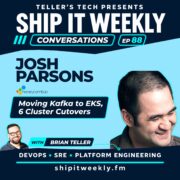
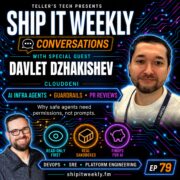
In this Ship It Conversations episode, I talk with Josh Parsons, Staff Software Engineer at Honeycomb, who led Honeycomb's move from self-hosted Confluent Platform and ZooKeeper on EC2 to open-source Apache Kafka in KRaft mode on EKS, run with Strimzi. Six clusters, each cut over in two to four hours, with Kafka in the middle of every event customers send.
Josh explains why the move was worth doing: Honeycomb Private Cloud needed open-source Kafka on EKS, per-node licensing made every scale-out a conversation, and the old setup still ran on Chef and SSH through bastion hosts. Then the constraint that shaped everything: Retriever keeps its own offsets and reads every partition in pairs, so MirrorMaker and other offset-translating replication tools were out.
We get into the choreographed cutover a December incident made possible (producers to the new cluster first, let the consumers drain the old one, then move the consumers, all switched with feature flags), retention and tiered storage, why NVMe instance storage over EBS means accepting hours of recovery for a lost broker, and why they terminate a broker every week to prove recovery works. Josh also covers the OpenTelemetry collectors and migration boards the team used to decide each next step.
His advice for your own big Kafka migration: start with the history and the business requirements, decide whether you really want to own Kafka, invest in teaching it, and set expectations with customers, not just engineering. What he's proudest of is the team running the last rehearsal while he was on PTO, faster than ever.
Ship It Weekly just turned one. Thank you for listening. The show is a 2026 DevOps Dozen finalist for Best DevOps Community Program or Event, and I'm one for Enterprise DevOps Champion of the Year. Voting is open through December 31.
Highlights
Why Honeycomb moved Kafka from Confluent Platform to EKS
Kafka, the beating heart of Honeycomb's ingest
Retriever's offsets and why MirrorMaker was out
The choreographed cutover, run with feature flags
NVMe vs. EBS, and terminating a broker every week
OpenTelemetry collectors and migration boards
Before a big Kafka migration: history and requirements
Josh Parsons is a Staff Software Engineer at Honeycomb, where he works on the core infrastructure and reliability behind Honeycomb's observability platform. He joined Honeycomb in early 2025 as its de facto Kafka expert and led the company's multi-month migration from self-hosted Confluent Platform and ZooKeeper on EC2 to open-source Apache Kafka in KRaft mode on AWS EKS. Before Honeycomb he worked in site reliability engineering and production operations for B2B SaaS systems.
25 years in production: DevOps, SRE, platform, and cloud. Host of Kube Signals on KubeFM. Grafana Champion; Confluent Community Catalyst; IBM Influencer 2026; DevOps Institute & ITIL Ambassador. 2026 DevOps Dozen finalist, Enterprise DevOps Champion of the Year.


Kafka is the kind of system you only notice when it's in trouble. At Honeycomb it sits in the middle of everything. Josh Parsons, who led their migration, put it simply: "We often call Kafka the beating heart of Honeycomb." Every event a customer sends goes through it, millions of them a second.
So when Honeycomb decided to move that heart from self-hosted Confluent Platform and ZooKeeper on EC2 to open-source Apache Kafka in KRaft mode on EKS, the hard question wasn't whether Kafka could run on Kubernetes. It was how to move it while customers kept sending data.
Josh said the idea had been "in the air for a really long time", since well before he joined Honeycomb in early 2025. What turned it from a pipe dream into a project was a stack of business reasons. Honeycomb Private Cloud, which lets customers run Honeycomb in their own cloud, needed open-source Kafka on EKS, and nobody wanted those customers on the hook for licensing. In SaaS, any time they needed to scale the cluster out, "it was a licensing conversation on a per node basis." And the old setup still ran on Chef, bastion hosts and SSH, while the rest of Honeycomb's services lived in Kubernetes with real CI and CD.
I like that the case wasn't "Kubernetes is better." It was licensing, scale, one way of running Kafka across the portfolio, and retiring legacy, all pointing the same direction.
The part of the conversation I keep coming back to is Retriever, the service that reads events out of Kafka and writes them to Honeycomb's columnar store. It doesn't commit offsets back to Kafka the way a normal consumer group does. It keeps them locally in checkpoints, and Retrievers are assigned to each partition in pairs that validate each other. As Josh put it: "So we have exactly twice semantics as it turns out."
That design took the usual migration tools off the table. MirrorMaker and other replication tools translate offsets, and Retriever's offsets have to be preserved exactly. The shape of the whole migration came from a requirement most teams wouldn't think to check until they were halfway in.
The way through came from an incident. In December, a disaster recovery test surfaced a problem in production that had never shown up in the lower environments, and the team had to evacuate a Kafka cluster. What they learned was that "Retriever can reset its offsets to zero", point at a new cluster and read from the beginning of the partition. That made a choreographed cutover possible: move the producers first, let the consumers finish reading the old cluster, then move the consumers. All of it was switched with feature flags, so nothing had to be redeployed halfway through.
Honeycomb runs its brokers on local NVMe instance storage instead of EBS volumes, for latency. The catch is recovery: lose a broker and rebuilding it is slow. Josh didn't dodge that. "We accept several hours of recovery time for a broker." What they get in return, in his words, "is guaranteed low latency through the system."
And they keep themselves honest about it. "We have a practice of terminating a Kafka broker every week. That's our kind of chaos testing and resiliency testing, right?"
Plenty of teams accept a recovery trade-off on paper. Far fewer break a broker every week to prove the recovery still works.
Honeycomb's SRE team had already set up good patterns for Kubernetes: Argo, Helm charts and Terraform. Strimzi fit into those. Josh credited its active community and its documentation for making it easy to map what they did in the EC2 and ZooKeeper world onto EKS, and said they could use its custom resources pretty much out of the box. The real porting work was Cruise Control for partition balancing and translating the server.properties settings they'd tuned on Confluent Platform. It was also their first time running KRaft controller clusters, so they had to learn those fairly deeply, and they went carefully: "a lot of this project really did focus on safety, guardrails, testing, practice."
You'd expect an observability company to have good telemetry, and they did, just not quite the right telemetry. On EC2 they had pulled metrics through Jolokia. For the migration they deployed OpenTelemetry collectors for the first time: Prometheus JMX receivers, a receiver for the Kafka admin API, and a fleet of collectors on every EKS node. That fed the migration boards, the queries the team checked at each step before moving to the next.
The surprise was which signal mattered most. "The visualizations that we really depended on that were migration specific were feature flags." The Kafka metrics said whether the clusters were healthy. The flags said where they were in the cutover.
When I asked what he'd tell someone with a big Kafka migration coming up, Josh started with history: know why things were built the way they were built, because decisions made years ago will shape what you can do now. Then gather the requirements, functional and non-functional. What do your consumers depend on? Is it okay if customers see gaps in data for a few minutes? "The solutions will sort themselves out once you've figured out the business requirements."
He also made a point I don't hear often enough: decide whether you actually want to own Kafka. A managed service you set and forget can be the right call. But if you're going to own it, "you can't really have Kafka expertise in one or two people's heads. That's just not going to scale." Honeycomb built what Josh called a pedagogical library, a guided path from "what even is this Kafka thing" to being ready to go on call for the new cluster.
The gotcha he warned about wasn't technical. "An organizational gotcha that we ran into was communication strategy with our customers." Honeycomb has written about it on its blog and in a public report. The lesson Josh took from it is to set expectations with everyone before something like this happens: not just engineering and product management, but customer success, the field team and customers too.
Josh's proudest moment wasn't a metric. It was the last non-production migration before the production ones, which his team ran while he was on PTO. "The thing that will stay with me forever is how the team grew." Six clusters, two to four hours each, several teams on every cutover, and the team that started out with one Kafka expert ran the last rehearsal without him, faster than they had ever done it.
That's my biggest takeaway, and it's what I said at the end of the conversation: the human side is just as important as the technical. A migration only one person can run isn't finished.
Josh's full write-up of the migration is on the Honeycomb blog, linked in the show notes.