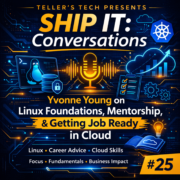
A lot of people trying to get into cloud or DevOps think the answer is learning more tools. Usually, it's the opposite. More focus, better fundamentals, more repetition, and a much clearer understanding of the business problem you are trying to solve. Because being job ready is not knowing everything.
It's knowing the basics, knowing how to learn, and knowing how to connect technical work to what actually matters for the business. Hey, I'm Brian. I work in DevOps and SRE and I run Tellers Tech. Ship It Weekly is where I filter the noise and focus on what actually matters when you are the one running infrastructure and owning reliability. Most weeks, it's a quick news recap. In between those, I do interview episodes with people who are actually building.
Teaching and mentoring in the space today is one of those interviews I'm joined by yvonne young a cloud and linux mentor who helps guide early career engineers through the cloud whistler community and this one is really about the real path in we talk about why linux still matters as a foundation why so many people stall out by trying to learn everything at once what job ready actually means and why consistency beats
Cramming every single time We also get into certifications, hands -on practice, how to keep skills from fading after the exam, how to talk about tools in terms of business outcomes, and what better onboarding and mentorship should actually look like for junior engineers.
If you like these kinds of conversations, follow the show wherever you listen, subscribe on YouTube, and check out shipitweekly .fm or tellerstech .com for more episodes, show notes, and everything else that I'm building. Alright, let's jump in. Today, I'm joined by Yvonne Young. She mentors young engineers through the Cloud Whistler community.
And we're talking about the real path into cloud DevOps, Linux fundamentals, daily reps, automation basics, and how to tie all of it back into business problems. Yvonne, thank you for joining me. Yeah, nice being here. I'm glad you invited me. So what's your core philosophy when you mentor someone trying to break into cloud or DevOps? Well, the first thing is to know what you're passionate about.
So there are a lot of ways you can go. You can go database engineer. You can go security. What do you want to do? So once you focus on that, then you can have a path. The other thing is important is to have a mentor. If you don't, it's going to take you a lot longer. So and a mentor in that field, because they'll guide you in the right direction. And when you have your career struggles, that's where it helps.
This other thing is joining a community. I can't stress how important the community is. You have support. You have people in your shoes. You have people that are more experienced than you are. And getting involved in a community and a mentor is a great way to start. And so you're part of the Cloud Whistler community, so that could help. And that's why we formed it. Just for that reason.
So to guide people, to have support, and some of the courses that we're offering, we offer through the community. So when you purchase some of our courses, you join our community, and then you get the support. And then the... Courses are through the Tech With Engineers? Yes. Is that correct? It's actually through Cloud Whistler.
So Tech With Engineers is the company, and then Cloud Whistler is the community from that company. And the course is based through Cloud Whistler. Awesome. So what do you think most people get wrong when they get into DevOps? They try to learn everything. They see all these cool tools. I'm going to learn that. I'm going to learn that. I'm going to learn that. Next thing you know, they're all over the place.
And then they... You know, there's no direction. So the first thing is, well, what are you like? Because you can't learn all the tools. So what are you going to learn? One of the things is once you decide what your passion is, you think about a company you want to work for and the role that you're targeting. So if you pick a role and you're targeting a role that is in the cloud, they use AWS.
OK, you can go in that direction. Are you into security database? Knowing what you want helps you guide in that direction. And then, of course, if you have a mentor. But the biggest problem is being all over the place as far as. And the other thing, let's say you have two certificates and you want to go for three. Do one at a time. You can't just focus on one at a time.
So that's another mistake is you do a little bit here and then next thing you know, you're not focused on one. Only and then not knowing which tool to study.
You know for it because some so what tools are important I'm looking at so the thing the business problems are security that's huge and businesses moving to the cloud and then microservices so you want tools for the cloud if you work for companies in the cloud and then security of course security tools you don't have to be a security expert to master a tool So for example, I'm going for Vault and not that I'm a security expert, but as IT professional, you need to be security conscious at all times.
Vault is, I picked that one because one of the business problems is securing the passwords, servers. And so a sequence management tool helps with that. And that's a big security problem. And using something like Vault, too, is also cloud agnostic. So you don't have to worry about getting into like AWS Secrets Manager specifically or GCP's version. Absolutely.
So actually, people who don't know Vault, with Vault, it ties into other services like AWS, Kubernetes. So you're one stop shop and then you have access to all the other providers. What does job ready actually mean to you? Job ready means that. You have done your research, you know, of the company that you're targeting, looked at the role and the description.
And when you prepare for the interview, you have two interviews you have to prepare for, a technical interview and a behavioral interview. So you need to prepare for both. So doing those things, practicing what you're going to say. And so I think I would say that the research, the questions you're going to ask, you think you're going to get asked.
And then thinking about the two types of energies you're going to have. They want to know if you fit culturally and they want to know your technical skills. The other thing is about not knowing everything. So it's kind of scary with the technical interview because you don't know what they're going to ask you. What you do is know the basics. Okay, you know the basics. Now, what if they ask you what you don't know?
Well, you don't know that. However, here's what I would do to find out if I were on the job. So now they know, oh, okay, they're very resourceful and also having a history of learning, a learning history. So you don't have to know everything. Just know the basics and let them know that you're a passionate learner and you can learn fast. Yeah. Let me get back to you on that or let me look into that.
It's OK, especially in our field. It's OK to not, you know, the imposter syndrome is such a big deal. Exactly. It's such a big thing. It's OK to not know everything. I've been in the industry 25 years. I don't know everything. Exactly. And, you know, I think it's important to. To recognize that and to have that humility in yourself to be like, okay, hey, I don't know this, but that's okay.
I know how to find the answer. Exactly. That's the most important thing. So you push Linux hard. We do. Why is that still a foundation? Crucial. Servers, all the servers run on Linux. The cloud runs on Linux. Everything runs on Linux. So you really, as an IT professional, you need to be versed in Linux. I mean, that's the basics. That's the foundation. So if you want to learn around all these tools, start with Linux.
And then you mentioned that, where do you start if you're getting into tech? Start with Linux. That's the best way to start. If you do your research, you'll find that on -prem, cloud, everything's Linux -based. I mean, they're Windows servers, but basically that's what you have. So that's why we push it so hard. It's very important. It's crucial. Not to be a master in Linux. Just know the basics. Just be functional.
Just, you know, know how to copy files, know how to backup, know how to see if you have enough disk space. Just the basics. And you'll be good to go. And then you learn from there. So I was looking online and I noticed that you talk a lot about practice and retention after certifications. What system kept your skills from fading? Yeah, oh, that's a huge one. So because I would learn. Learn something, right?
And then I would drop it for a few days and then I would go back to it and I would go to run a command. And I'm like, I have to think about that. I forget it. So there's so many commands. So I say, after you get your basics and get your certification, practice, you know, an hour a day, 30 minutes a day, keep it fresh. And I actually have a checklist of things I'm going to study a day.
And I might do 30, 45 minutes daily and just the basics. Just to keep it fresh. The thing is, is there's so many commands and it leaves you. It's just, you know, it leaves you. And when you go on an interview, they're going to ask you the basics. They're not going to ask you, you know, complicated stuff. Can you copy a file? Can you move a file? Can you back up? Can you zip a file? So just the basics.
So if you just study the basics daily, let's say, and I say 30 minutes because people don't have time and I get that. So you don't have an hour. 30 minutes, or just put your finger on it at some point. If you can't do it every day, every other day is fine too. But just to, you have to do that, it will leave you. Also, before an interview, you have to stay consistent. And before an interview, brush up.
And like I said, going on an interview, just know the basics. They're not going to have you build a server with Linux on an interview. Just the basics. Another thing I thought, know how to use the help file. So they ask you a question and they ask you to share your screen and you forget a command. Hold up, let me go to the help file. So they see that you know how to use the help file to find your answer.
So that's what I would do. Know where the main pages are, know how to read them, know how to read the help flags for each command.
Yeah that's what the techs do especially if you don't use it especially if you don't use the commands every day because there are commands that you're not going to use every day so you're going to look those up yeah it's it's funny I'm thinking back to like sed and awk I I can't tell you every flag and every yeah it's you can't remember it all um and forget regex if you're getting into regex I mean it's That's still a black hole for me to a certain extent.
So I think I did write a post about remembering. I can't remember. It was a couple of posts back. You may have read it about keeping it fresh. Yeah, so consistency. That's the other thing. You said something really important, consistency. So I see people, they study for two days, then they let it go for four or five days, then they pick it up again. Then they go a couple of days. That consistency really does pay off.
And it doesn't have, here's the thing. It doesn't have to be an hour, two hours, short times, just a short time. That's it. And then brush up before an interview. Okay. So after you start getting some skills, you're getting some familiarity. Maybe the next step is you start thinking about certifications. Can you explain to me, I know there's like RHCSA and RC.
RHCE, what are the differences and what would you recommend as far as certifications? So Red Hat Certified Systems Administrator. You start with that. And then Red Hat Certified Systems Engineer, Certified Engineer. I would start with RHC and say that's the basic. Engineer, the engineer course is a higher level. And that would be Ali Sohail's expertise. So definitely start with that. It's challenging.
It takes you to the next level. What's great about that is the exam is hands -on. So you really get hands -on, you know, practicing it and learning it. So it's valued because they know you have hands -on skill. That's why it's so valued. It's different from an exam where you have to memorize the, you know, the two -foul, you know, pick this one. You can memorize those.
But to ask you to actually do something, run the commands, that's a different story. So that's a great thing about that certification. What's a hands -on project you would give someone that would prove real skill? Oh, what I would do is, first, you know how to set up a VMware or VirtualBox. And then, let me see, just troubleshooting. So let's say you learn all these commands. Let's say SELinux.
You do something to break it, and then you see if you can troubleshoot it. You know the firewall commands you know commands to see if if you can run so I I think troubleshooting trying to think of an example Yeah. If you can set up an SE Linux server and then break it, and then the commands you would run to find out what's wrong with it, I would say that just to the status, check the status. Okay.
You can see a service is not active. Okay. If it's not active, what do you do to make it active? That kind of thing. So the commands to make it active, the commands to check the status, the command to check the ports or just to view the ports. Are there any ports open? That kind of thing. So it's checking ports, checking the status, firewall. So I say troubleshooting, breaking things and then fixing.
Because I just thought of something. So you can learn all the commands. Now something is broken, what command do you run to troubleshoot? And so you just start with the basics. You just run system CTL status. How do you teach juniors to translate tech work into business outcomes? I would say... This is a good one. So whatever tool you learn, understand what business problem they're trying to solve.
So, for example, why does a company want to go to the cloud? I mean, and maybe some companies are on -prem. How do you convince them to go to the cloud? So convince them about saving money instead of getting physical servers, being more efficient, being able to spin up servers really quickly as opposed to the hardware. So understanding. That's another good point you brought up. So you're learning all these tools.
Why are we learning these tools? You're trying to solve a business problem. The cloud, for example, being efficient. Vault, for example, security. So it's not so much the tools, understanding the business problem you're trying to solve. So I stress that a lot. Why are we learning these tools? So that's what I talk about. And I get Vault as an example. Let's give you an example. One of the business problems.
Is uh what's called secret sprawl and basically a secret is anything that a company finds valuable that would be a breach of if the bad act has got it so passwords you know encryption keys so secrets fall are those those secrets that are everywhere in the company someone's desktop somewhere in someone's excel file you got these passwords that everywhere secret sprawl the tool vault solves that problem by putting everything centralized and encrypting it and keeping it secure and only let certain people access it.
But that's a serious business problem. I mean, people, you got the DevOps that has the passwords over there, you got the... SysEngineer, they got the password there. They're sharing passwords. Someone leaves the company and they have the password. So that's a serious business problem. So that's an example. And rotating, even just rotating those secrets too. Exactly.
That's where dynamic password generation comes with Vault. So talking about Vault, not the tool itself, it's the business problem you're trying to solve. Because there are other management tools out there. What are we trying to do? So I don't promote the... Tool more so is what are we trying to solve? Yeah. And there are like, there's OpenBao, which is open source versions. Yeah, that's right.
If you don't want to get into the HashiCorp ecosystem specifically. Exactly. Yeah. That's why I say, you know, I focus on the tool. It's exactly because there's other options out there. So, okay. Let's say someone's, they've.
Learned some linux they've they've learned a little bit about secrets management they want to get into cloud where where should they start once they've they've gotten a little bit of that foundation level with with linux and some understanding what secrets are and rotating secrets where do they go from there as far as cloud or as far as devops practices so the as far as devops and cloud different companies use different cloud technologies you've got azure you've got aws So you don't have to know them all.
You can learn one and then you learn another one on the job. So just pick your poison or target. Let's say you want to work for a company. What are they using? Okay, they're using Azure. Okay, let's go in that direction. So learning the basics, cloud basics. Why do companies use the cloud? Why do they need it? And then knowing, understanding why we want the technology. It's huge. Technology is huge.
So as far as the course, there are a lot of... Basics courses out there, but I believe in technology, you do need to know cloud security basics and cloud basics, at least. So those are the actual, those are the big things that companies want to solve. Microservices, security, cloud. That's just top of the list is more, but so. So like objects, storage, databases, instances, and like microservices. Microservices.
So Kubernetes is one. Thank you. So. And then it depends on the, see, that's the thing. It depends on the company. If it's a large company like IBM, you got Volt, you have, if it's a smaller company, not all companies use all those technologies. So where are you going? Do you want to work for a small company? Okay, what technology are they using? Do you want to work a mid -sized company? So it depends.
The other thing is if you learn AWS, well, if you get in a company that works with Azure, you can learn Azure. That's not a problem. But you understand the concept of the cloud. So it's not the tool you learn. It's understanding that you know cloud technology. It's the principle behind why companies are using the cloud. But I think cloud basics is important. Linux basics is important. And security.
Those are the three things that you want to start with and be conscious of. The security, that's a whole different level. If someone wants to get into security, it takes a while to get in that industry to be... A security expert, every IT professional should be security conscious, know how to use security tools, you know. So that goes without saying.
So you can use the tool, but you don't have to be a security expert. But you need to be, that should be on the top of everyone's, that's number one. And if you want to get more specific into security, there is like DevSecOps or SecOps specific practices you could get into. Yes, there are. Absolutely, there are. And that's a whole different.
Yeah, it's a completely different world that you get into dealing with audits and doing like audits for companies or providing evidence for audits. Yeah, and I just thought of something. So you brought up a good question. Where do they start? It's huge. You can go security. You can go infrastructure. You can go SRE, site reliability engineer. With all these choices, you decide what do you want to do?
What do you like? What are you passionate about? Because you can't split yourself everywhere. So once you decide, okay, I like cloud. I like database. Now you can hone that down to what you want to do. So I think part of it is knowing what you're passionate about. If you take a job just because there's a nice paycheck, And you get into databases and you don't like databases. Oh, well.
So I think I start them with, what do you like? What do you want? I mean, what are you passionate about? Yeah. Yeah. What are you going to spend time on learning? What are you actually going to, you talked about the consistency earlier. What are you going to, what's going to drive you to be consistent?
What's something that has passion or at least some passion for you that you could, you can continue learning in without it being a struggle or a real, like real, real hard effort. And then you just, then you kind of hone. You can focus on the direction you want to go in because you're just honing it down. Let's say it's cloud.
The other thing, mentorship is huge because without a mentor, you're going to be, you know, wandering. A mentor in your area that you want, let's say another Linux or professional, joining a community and having a mentor is huge. Because trying to do it by yourself, you're going to wind up maybe in the wrong direction. But mentors definitely, because they have the experience, they know they can advise you.
And when you have struggles, they can tell you what they did when they had struggles. So it's really, really important. And it's easy to find, if you join a community, now you have that connection to find a mentor and talk and share. So regarding cloud community. Cloud Whistler. Yeah. Can you tell me a little, can you tell me a little bit about Cloud Whistler and what, yeah. Yeah. It was founded by Ali Sohail.
His idea was just what I was talking about to support people, not only junior engineers, but people getting into tech and people changing careers because people say they're tired. They want to get out and do something else or upskilling. You know, they've been doing the same thing on -prem for years. They want to get into the cloud. So he founded it and he's instrumental and he's a driving force in there.
He's really, he's great. Huge support, training, mentoring. And people where you are, if you're struggling with certain things, people are struggling along with you. So it's a good community. And the training that he's advertising comes from Cloud Whistling. So you would get the course, join the community, and then you would get the support.
So if you look at Ali Sol's latest posts, he's advertising the RACSA and RAC, RAC Ansible training. And so if you go to his LinkedIn profile. The latest post talks about that, the training and joining a community. Very cool. So where can people join this community? If you go on Ali's LinkedIn profile, actually, you can reach out to him. But I believe if you go to his post, there's a link there.
And if not, you can reach out to him directly and he'll reply. Ali Sohail on LinkedIn. His last name is S -O -H -A -I -L. I'll go ahead and leave. In the show notes, I'll leave links to his profile and the community itself. All right. Anything else that we didn't talk about that you wanted to talk about? I think the thing about the learning is. What we just say about learning is focus on one thing at a time.
Don't try to do too many things at a time because then you won't be focused. You need to focus on one thing at a time. Understand the business problem that you're trying to solve. Like, why are you learning these tools? You're not learning it just for the sake of learning. Yeah. So having focus is really important. Having focus. And you're not going to know everything.
You can't, you know, there are all these tools out there. Just focus on what you like.
Focus on what's important and the business problems that are solved I see in cloud security microservices those are the those are the problems and that's why these tools tools are there and what what we believe in teaching is those videos are very our videos are short so I did a devops video course and the videos are like 10 minutes five minutes you know no longer than 15 minutes because you You learn in short, short sections.
So you learn 10 minutes video, then you take a break. So they're all short as opposed to you sitting for an hour for an entire video for an hour. So that really helps. And also regarding studying, there's a philosophy behind studying. Studying for three hours nonstop is not effective. Studying for 20 minutes, taking a break. At a time is effective.
And I actually have a tool based on the Pomodoro system where you study for 20 minutes, take a break, then come back. Because otherwise I'd fall into that trap too. You just keep studying, taking a break. You can also take a day, let's say you're burned out studying, don't study the next day. You don't have to study every day. You can take a break, let your brain learn it and then come back to it.
And then you don't want to get burned out. That's for sure. Don't want to get burned out. Sleep is crucial. I know people disregard it, but when you get, when you're well rested, you can, you think, you think better. I think this in the morning, in the morning, I can climb Mount Everest in the morning. In the evening, I feel good. So yeah, it's yeah. So it's important to pace yourself studying. Don't study.
Try to cram everything in. Get, you know, rest, exercise, all that does play a part in there. Because what I see in the tech industry, they focus on study, study, study, study. Well, how about exercise? How about sleep? How about taking a break? How about being balanced? When you're not balanced, you can't just focus on technology only. You have to be balanced. And if you're not, you're not going to learn as well.
And you're going to burn out. Yeah, your attention span can only... You only have attention span for so long. And then eventually, yeah, you're just not, it's not, even if you are studying for three hours, it's not an effective three hours of studying either. It's not. And that's why they invented that Pomodoro system because they did study saying, okay, 25, 30 minutes, stop, take a break, then go back. Yeah. Yeah.
And take the time to take care of your health, take care of your, enjoy hobbies outside of tech too. So you can, yeah, turn your brain off. Help recharge and not get burned out. And the other thing is studying that people don't realize. Your brain is fatigued, but you don't know it. So three hours you've been studying, studying, studying.
You're wondering why you can't remember anymore because you've been studying for three hours without stopping. So we talk about that when we're mentoring about those kind of things, about doing it all at once. Yeah, I think I pretty much said it all. Basically learning the basics of technology. You can't learn it all. Understanding business problems. That's the other thing.
Going on an interview, I just thought of it. Talking about your tools. I don't talk about the tools. I talk, I understand about this is a business problem you're trying to solve. And here's what I understand about this tool. And what do you do? What does your company do to solve this problem? So they understand you're thinking about the big picture, not just focusing on a tool. That's another thing, understanding.
And then they see, oh, you see the big picture. So being a mentor, so wrapping up, and I just wanted to ask one more question. Being a mentor in this space, you have visibility to both the juniors and the seniors and the people that have been in it for a short period of time, been in it for a long period of time. What's one thing you wish more seniors would do for juniors? Well, that's a good one. You mean on the job or just in general? In general, yeah.
In general or on the job if that's a if that's an easier question well on the job I have something to say about on the job a lot of times you know there's a instance where it's a fast -paced company they throw you in there and then the seniors are all busy and you didn't really get the good best onboarding and you you get stuck and there's nobody around so good onboarding for me is okay good onboarding you have a
Mentor that you can reach out to if you get struggle and I think that that's huge Just having that lifeline to be able to reach out.
Sometimes you get dropped in, you sink or swim. And the thing is, what's going on is big companies have the time and the resources to train you, to give great onboarding. These small startups and small and mid -sized companies, well, they might not have that. Everybody's busy. It's good to have a good mentor. Actually, let me think about that question. Well, with me as a mentor, I'm just always available.
I mean, no matter how busy I am, I'm always available. I always find time. And I understand them because I've been there. So just being available and listening. That's a lot. That's a lot. Yeah. I mean, it seems simple, but it also isn't done enough. Yeah. What's happened is everybody's busy. My mentoring started when, because I was thrown in Sing or Swim. Actually, they threw me in and I swam. But it wasn't easy.
It wasn't easy, but I did it. And then after I got through it, I said, you know what? Everybody doesn't have to go through that. So I actually volunteered myself to be a mentor for onboarding techs at my company. So they can reach out to me at any time. And they said I made their life so much easier because I went through it. So I understood. No, it's great to be in that position where you can help others. Yeah.
Not go through the same experience that unfortunately you had to go through. I got through it. Yeah, it's awesome. Well, thank you Yvonne for being here. I really appreciate it. I'll keep, I will put show notes in the show notes. I'll put links for, for Ollie's profile. And they can reach out to him directly. And then he had his latest post talks about the training that the upcoming training that we're having. Cool.
So I will put show notes down for Cloud Whistler Community Tech with Engineers, Ali's profile, your profile. Yep. Really appreciate it. Thank you for being here. Yeah. Thanks for inviting me. It was fun. All right, that's my conversation with Yvonne Young. My biggest takeaway from this one is the path into cloud or DevOps does not need to be flashy. It needs to be focused. Pick a direction. Learn the fundamentals.
Practice consistently. Understand the business problem behind the tool. And do not confuse collecting buzzwords with actually being job ready. I also really liked her point that good mentorship can save people a ton of wasted time. A lot of juniors do not need more noise. They need better guidance, better onboarding, and someone who is actually available when they get stuck.
If you enjoyed this episode, follow Ship It Weekly wherever you listen to podcasts. If you want the show notes, links to Yvonne, Cloud Whistler, and the resources we talked about, head over to shipitweekly .fm or tellerstech .com. Thanks for listening and I'll see you later this week.