Deployment was supposed to get easier. We got cloud platforms, containers, Kubernetes, Terraform, GitOps, internal developer platforms, and now AI agents that can generate code faster than most teams can review it. And yet, for a lot of teams, shipping software still feels weirdly painful. Not because people do not know how to deploy. Because deployment is where all the hidden complexity shows up.
The app stack, the runtime, the registry, the secrets, the networking, the database, the cloud provider, the rollback path, the weird internal Jenkins job nobody wants to touch. And for smaller teams, that can be brutal. They do not always need every knob Kubernetes gives them. They do not always need a giant platform engineering program.
Sometimes they just need a clean way to build, deploy, get logs, roll back, and move on. So maybe the future of deployment is not more flexibility. Maybe it is fewer decisions, better defaults, and picking the right opinions to outsource. I'm Brian Teller from Teller's Tech, and this is Ship It Weekly.
Welcome back to Ship It Weekly, where I filter the noise and focus on what actually matters when you are the one running infrastructure and owning reliability. Most weeks, it's a quick news recap. In between those, I do conversation episodes with people who are building platforms, running infrastructure, organizing events, and thinking through where this industry is actually headed.
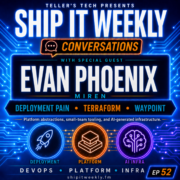
Today is one of those conversations. I'm joined by Evan Phoenix, CEO of Miren. Evan previously worked on Terraform Enterprise and Waypoint at HashiCorp. And he also built Puma and Rubinius. We talk about why deployment is still painful. What teams keep getting wrong when they try to simplify it. And why small teams may not need more knobs. They may need better opinions.
There is also a good thread in here around Terraform. OpenTofu, Terragrunt, Waypoint, platform abstractions, and what happens when tools make users do too much homework before they get value. We also get into AI because yes, AI can generate infrastructure code, but when that generated deployment setup breaks, who is on call for it? And does anyone actually understand why it was wired together that way?
So if you work in DevOps, platform engineering, infrastructure, developer experience, or you have ever stared at a deployment system and thought, why is this still so annoying? This one should be worth your time. All right, let's jump in. Today, I'm joined by Evan Phoenix. He is the CEO of Miren, previously worked at Terraform Enterprise and Waypoint at HashiCorp. And he built Puma and Rubinius.
We're talking about why deployment is so painful and what teams keep getting wrong when they try to simplify it. Evan, thank you for joining me. Oh, my pleasure. Glad to be here. So walk me through your history in tech. It's kind of interesting. I'm curious. How did you land where you are now? Well, I'm old enough that I graduated from college right after the bubble burst. The dot-com bubble burst.
And so a lot of my career is actually informed by lack of opportunity post bubble bursting. I did all kinds of crazy interviews trying to just get any job. I almost wrote web Perl for many interviews and stuff like that. I couldn't get anything. And so I end up working for like a tiny ISP in Seattle. And then from there, I kind of just.
Was sort of scrapping I was like you know I met a guy in a hallway and he told me about this company he's working at and so I went to lunch and the lunch turned into a job interview and I worked at that company for a number of years and so like I didn't have any a moment where it was like oh there's this big thing and so I kind of was jumping around and the other out the other part of it was I started doing open source work in the late 90s at this point.
And I did it all the way through college and then into my first few jobs. My first few jobs were, I was working at a three -person ISP. So I wasn't programming. I was like, open source is what I had for programming. And so I did that for a long time. And then I actually, the company I was working for in Seattle at the time was spinning down. I had a Ruby project and I actually got.
Hired by Engine Yard, for people who remember Engine Yard from the Ruby days, and to basically work on Rubinius, my Ruby implementation, and then also help out with sysadmin work. And I kept ignoring the sysadmin work and just working on Rubinius. And so they were like, I'll just do that. So I got to work on my open source project for like five years. They just basically paid me. It's like living the dream. And so like that.
Sort of balance like working on open source and then finding a job and finding interesting things and working on open source has been this sort of constant thing and then it it carried me through many jobs it carried me into uh a startup that I had before HashiCorp and then HashiCorp is a great sort of like job and open source thing that carried me all the way through that and then my current venture Miren is a
Similar sort of thing it's like job and open source and all kinds of things and so yeah it's been that's the that's the short long version Very cool.
So my first job was, to date myself to a degree, was doing dial -up tech support. Yeah. Me too. That was the ISP. Yeah. I did dial -up tech support. I did DSL tech support. And then we were putting wireless antennas on people's houses around Seattle. For long range. Yeah. It was sort of long range. But yeah, directional. Yes, yes. But big antennas.
That was actually how I got the, how that guy in the hallway talked to me was because I was carrying a giant antenna. And he was like, what is going on here? And I explained it to him. He's like, we should have lunch. And then, yeah, one thing or another. But yeah. That's awesome. So where does Miren fit in? What is Miren and how does it fit into the ecosystem? So, I mean, it's a software deployment system.
It comes out of me constantly feeling like we are always struggling with deployment systems, right? Like people, I have... People have lots of great ideas and especially now with coding agents, you know, getting an idea out there and getting it like, oh, my gosh, I got this idea and I want to put the code together. And then you have to figure out, like, how do I give this to somebody?
How do I let somebody else use this? It's always like it breaks you completely out of your rhythm. And so the like one of the original ideas was like, how do we integrate deployment?
Actually into sort of the software development life cycle right so that it's like it's not this thing where like I spent all this time and now like oh god now I got to deal with deployment but it's like oh deployment is part of that I go through a deploy I can get the logs it feels like it's part of the process and so I I've worked with Kubernetes I worked with Nomad I worked with lot most of the AWS products to do deployment and I felt like They're always missing something.
And I wanted to feel like I had my own things to say about where that fit in. And the first cut of it is a self -hosted piece of software. So it's open source. You go and you run it wherever you want to run it. And so that makes it very accessible. That opens the doorway to lots of different people who have different needs. You want to data sovereignty. You want, oh, I'm really cost conscious.
I want to run it in one particular way. And one of the big things. To do it for us was like, hey, you've got this open source. You can run the deployment system on your laptop. You can just deploy to your laptop. And then when you're going and you're deploying to production, it's the same. It's exactly the same.
And so you've got all of these, all of your rhythm about how do I do it and how do I work is exactly the same. And so now you become that much more comfortable with the system and then you can sort of grow with it. That's awesome. That's great to hear. Okay, so. Why is deployment still such a mess after years of platforms and abstractions? Why? What's going on?
Yeah, I mean, it really is the final boss in some ways of software. I think that it has to do with a few different things. I think that if we all were working in sort of one stack. One system, I think it would be a lot simpler. I don't think we'd be as happy, but I think that deployment would be simpler. And because then there would be just fewer knobs.
There'd be, you know, like all the, you know, if Java, maybe, maybe not. I mean, it's not like Java beans really solved all of the problems of the, you know, like the late 90s, early 2000s. But there are so many different shapes that an application comes in. And some of that are just within the stack. One JavaScript app could be completely different and have a completely different profile than the next one.
But then you multiply that matrix by all the different stacks and all the different things. And now you've got sort of a giant 3D cube of different ways that an app can behave. And I think that deployment systems try to say, OK, I want to do I want to give the power of all of these things all at once?
And if so, I have to let you configure every possible thing on here so that I can have every possible stack here, right? And sometimes they're like, well, that's really too difficult. Most people are in this one quadrant. Let's actually focus on the kind of apps that look in this shape, your HTTP apps, request times under a second, whatever it might be.
And great, let's sort of focus on that and try to distill down the needs and the function and that kind of thing and make it better. I think that, I do actually think it's better now than it used to be. I actually think there was a time where it was.
Better than it is now also but like it's just because of the number of variables that come into it and then what each platform each platform wants to have a unique say on it right so they want to say like oh well we've got this cool load balancer and so you should lean on the load balancer and now I'm like okay I gotta learn load balancer and I gotta learn all this kind of stuff right and so or uh you know AWS is
Like great for like oh we've got these AWS specific services to like make your app work in this one way of these different shapes and so it's the the amount of configuration the amount of of of functionality that you want to sort of eek from the platform too you think ai helps us bridge that gap better I mean in some ways yes in some ways because it's really good ai is really good at if you could if a platform can explain itself The AI is really good at being like, okay, great.
The platform works like this. I'm going to basically match the app to the platform, right? So the platform can have a bunch of different things it does well, things that it doesn't do well. And the AI can say like, okay, I'm going to make the app work. You wanted this platform. Great. I'm going to plug you into it. The inverse is also true, although I don't think we're seeing it that much yet.
The app exists as this thing, and the AI is like, great, let me find the deployment platform that fits this. I don't think we're seeing that quite yet, maybe eventually. I do think it's making it better. Okay, so you've lived through multiple waves of this will fix it. What did people misunderstand about Terraform Enterprise early on? You know, we were constantly trying to figure out the shape of it.
There's a whole Conway's Law situation with Terraform Enterprise, right? So we were constantly trying to help people figure out the shape of like, what should their repos look like? So in other words, like, should it be like there's a repo called Infra and it has like a thousand modules that are basically going and configuring all these different things.
And every time anybody changes anything, we have to run a plan that basically touches like, you know. 1 ,500 resources or something like that, right? Do you want that? Or do you want like, oh, well, I want my, like, should it be tiered? So it's like, okay, the load balancers are a module, a thing, there's like infra -loadlb, and that's just the load balancers.
And so it was, and I don't know that Terraform really ever figured this out. Even to this day, if I'm honest. But people were constantly, that was the big question. We had white glove service at HashiCorp at one point that was like, how do I organize my Terraform modules, right? In a way that's like, that I can apply them quickly, that reduces the blast radius, all of those sorts of things.
And so I think that was a really interesting thing that, and that wasn't Terraform Enterprise specifically, that was Terraform writ large. I think Terraform Enterprise was a, The first version of Terraform Enterprise was the one that I worked on where it was for people who wanted the experience of having a platform that ran Terraform for them, but they needed to have it sort of inside their silo, whatever that meant.
And so we went through a few iterations where basically it was just like a – big machine like we scaled it vertically inside the actual instance and then you would just it would just run Terraform on on instance and it was a like so many products when you see how the sausage is made underneath you're like this is all we're doing you know like it was a little bit that in a good way because it basically made it made
The product easy to manage and and simple and stuff like that like we were constantly like stripping things out and taking things out and like you know at one point the product was dependent upon RabbitMQ and we're like, no, we need to like tear, like slice this down.
Like that's too big of a complexity for a thing that's just running on a single machine. And so. Is that for like worker queues? Yeah, for worker queues.
Because that was, so at the time, this is Terraform Enterprise is a product before Terraform Cloud, which is a weird sequencing because we had Atlas at the time, which was the thing that predated HCP which was like our all-in-one platform and uh Terraform Enterprise existed as sort of a side thing to atlas and then atlas eventually gets broken apart part of it became Terraform Cloud we still have uh Terraform
Enterprise and so that rabbit mq part came from the original vision of atlas yeah believe it or not I was an early uh customer to Terraform Enterprise yeah I we so probably much like a lot of the customers we we had a pci HIPAA requirement where we needed to have state files managed locally.
We needed to make sure that everything was self -contained and then eventually move to Terraform Cloud. Did you use it in the... You weren't at desk.com, were you? It was not, no. Was it a forms company at the time? There's three shapes of Terraform Enterprise. The first, the shape number one was only ever seen by like two customers. Oh, okay. One of which was desk.com when they got bought by Salesforce.
And then the second one was the AWS only Terraform Enterprise where we basically shared an AMI and a bunch of Terraform for you to run it. That was shape number two. Okay. And then shape number three was a rewrite that I did, which made it basically Docker -based. And then you can install it anywhere. I forget the name of the application that it was built on. Replicated. Replicated, yes.
I remember going through and dealing with weird Docker IP address allocation issues. All the time, yes. So yeah, I guess it was version three. But yeah, it was a good product. We eventually moved to Terraform Cloud. And then I think they've since, I don't know what the company does now. It was a few years ago.
But it got me excited about IaC because at the time, and this is going to cause a lot of people to cringe, I was at a company where we were using Ansible with no state. We were just using Boto3 to manage infrastructure, some CDK stuff. So going from that to Terraform was a huge jump.
More recently, the problem you were describing earlier, just about how do you manage state files, how do you manage environments, how do you manage modules, I feel like Terragrunt has really tried to answer that problem. I don't know that they've answered it well, to be honest with you, but I think they've tried at least to answer some of that dry issue. Yeah.
I mean, they were around right when I was at HashiCorp because the Terragrunt has been around for maybe not 10 years, but quite a while at this point. Yeah. And they had this idea of like, how do you slice your Terraform and we'll basically like put it in different shapes.
And they were very successful at basically saying, we're not going to let you like Terraform in some ways, let you do anything, let you put files wherever and let you organize it. However, in Terragrunt was like, what if I just put like a corral, like I put like a little, like a little.
Guard around this thing you can't do all this stuff it's just like it's going to work like this and and that is very powerful from a workflows perspective because now people are they're having to comport themselves maybe to this smaller feature set but they're also not having to think as much because they're basically being like no it works like this like I'm supposed to supposed to put it in these boxes we think
About that a lot about that at Miren because Part of it is what do you want someone to have an opinion about?
Like Terraform made you have opinions about like file structure and stuff like that. Right. Terragrunt is all about like, OK, well, let's not like people have an opinion about all of these things. Let's just make those opinions for them and we'll just tell them what they are. And then they're not having to go around, go about, figure out, like, should I have an opinion about this?
Like a lot of people, when they would start using Terraform, they're like, but just can you just tell me what the right pattern is? And they're like, well, like, did you do that?
Or does it think this or what you know whatever and so uh they would we would sort of force them in some ways to have an opinion about stuff that they didn't really want to have an opinion about that's fair so where do you think OpenTofu sits in that opinionated stack against Terraform Terragrunt yeah at least whatever other alternatives there are well I think open tofu is the result of two specific things obviously
Number one was a license change without a question no no no question right but I think that the second one is part of it which is that the backlog of potential features for Terraform that we're sitting in PRs or sitting in issues that the Terraform team was like no we're not going to do that no we're not going to do that and so the the uh The license change catalyzed people to be like, okay, well, I want a different thing.
And then it got runway because it was like, well, look at all these PRs. Look at all these really cool features that Terraform team never wanted to do that will just do those things, right? And so now it's like it's growing all these different, growing in this sort of different direction because of that, right?
It might still exist even if there wasn't all those features, but I don't think it would have had the legs that it has had. If it didn't have that second part, right? And I think that what's interesting is that I was at HashiCorp during the creation of OpenTofu. So we were talking about it and we were trying to figure out what it meant.
And what was interesting is that OpenTofu was taking on these features that Terraform was rejecting.
For good reason right so there was a lot of interesting features there's encryption encrypted state management was one of the big things that OpenTofu took on that Terraform was like don't do this do not like the reason that they didn't do it for the longest time was because like we we run the math and if you do this what you end up doing is that you create like this other big hairy availability scenario that is now
I want to do stuff and now I've lost the keys to do stuff and now I can't do anything I'm sort of like really dead in the water and so they were like an advocate for like do it a different way right they had all these different things and so and again like maybe that's an example of where Terraform was like actually don't let people do everything they were trying to sort of rein in the the sort of field of opinion
And and in some ways OpenTofu is like even wider like now you can do all these things and maybe some of them are good ideas but at least people are trying them out so well in secrets probably shouldn't be in state right or anything too sensitive or if it is I mean lock it down otherwise but but maybe that's the answer like I'm sure they were pushing like Vault and like using yeah that was really that was that part of
It was really interesting because that was the sort of the evolution of how of your state files as definitive reproducible data right so like one of the reasons early on in Terraform that Terraform would end up having secrets inside of it was because they were like look like the state file needs to be the thing the the the the jewel that you can use to recreate whatever you need right and so they they were like you
Should put secrets in your state file because you want to do this and the other thing and then what they sort of realized over time was that like that's a that's a hard position to to have defense for when Terraform depends on a jillion other APIs.
And so it's like, okay, well, if it already depends on all these other APIs to work anyway, can't you just make secrets an API that you have to depend on? And then that became a thing that they sort of moved towards. In my opinion, they didn't move towards it.
Quick enough like in other words I I always felt like hey if you're gonna have secrets just make make a secrets part of Terraform Cloud and let secrets live there your state files can basically just like not have secrets in them no matter where you are you can just sort of outsource the secret management part to Terraform Cloud um that was kind of the idea with variable sets though right I mean yeah whether it's
Exactly right that's exactly right yes that's exactly right but it could have been at a deeper integration level no right so yeah for sure So what did you learn about what devs want versus what they think they want when it comes to tools like Waypoint?
Yeah, well, Mitchell and I started Waypoint in 2019, which was an interesting time to start a new product because right in late 2019. And I think that the thing that we were really focused on was a control plane. For backend deployment systems. So it would be like you would talk to Waypoint, and Waypoint would go off and do things like, oh, to do that, I need to build a container. Let me go build a container.
And then, OK, great, I will do this, and I will do this other thing, and I will do this third thing. And the idea was it was just a pure workflow engine for deployment. And it farmed out all of its backends to do different things. And one of the things that I learned working on that was You're asking a lot of someone who wants to use this thing to say it doesn't do anything until you do all of this homework first.
Right. It was a lot of homework to get to get Waypoint running. And that kind of sucked. Right. Like from just from a usability perspective. But it also it wasn't great from like we're working on a perspective. One of the things that we we found out that was like a like a really big hurdle was people.
People would get to the point where they're like, oh, like, oh, I just saw this on a system and it can run, it can build Docker containers. And that part was easy because we would just say, also run Docker on the same machine that you want to run Waypoint. Like that was sort of, we could easily pave over that. But then they'd be like, okay, now I want to deploy this to ECS.
And we'd be like, okay, well, you got to go. You have to go configure, like, container registry, and then you've got to push it to the configure push to push the container registry, and then you've got to tell the container registry over here to pull. And it was like just that, just getting over the, like, where does this image go was a leap. It was a big hurdle for people to get over. Sometimes it was too big.
Like, they wouldn't even get past that point. And so we worked on it to try to. To pave over it. One of the things that I did was I made it so that if you were using, let's say, ECS as an example, we would automatically configure a repo inside AWS's OCI registry to push those images to. So we would kind of just try to pave over that as much as we could.
But the learning experience I took away from it was like, a pure workflow engine, it's not enough product. It's not enough unless there's this really complicated thing that people are doing that you're like, I want to come in and I want to just revolutionize this one segment with a workflow engine. Great. But deployment wasn't that. And what they really needed was they needed answers.
It didn't need to be all the answers, but they needed a lot of answers that were already set in stone at the beginning. So when I was going to deploy stuff, I was like, it just deployed. It just did the thing. And part of that comes out of the idea of like. Again, from HashiCorp that we learned was people wanted us to have opinions, right? They really wanted HashiCorp's opinions.
They want to say like, well, okay, well, like great, it's Terraform, it's Vault, it's Nomad, but how do I set it up? Like, what's the best way? All this kind of stuff. They'd constantly be asking for our opinions, even though we had these sort of generic tools. And so the takeaway that I took from it was like, well, let's just build a really opinionated tool, right? Let's go in and say, hey, we've got opinions.
We've been working in the field for all this time. We've got opinions about how this stuff should work and what it should do and how it should feel and what the primitive should be. And we think that if you agree with those things, you will really like our thing because it just does all those things, right?
It's sort of really defining that in -group of people who want something that looks and feels in a specific way. And so we... When we were working on Miren and from Waypoint, we took that opposite approach. We're like, let's just build all the pieces. Let's build the thing that builds stuff. That builds the thing that deploys it. Let's not tell people where stuff's being stored, where the images are.
Let's just make that not a problem at all that people have to think about and worry about. And that was a big takeaway from Waypoint, right? Waypoint, it never really got traction and it really got its legs underneath it. Partly, I think, because it didn't have enough opinions. It didn't have enough opinions about how someone should actually use this thing.
And then just because of things that were happening inside HashiCorp at the time, it ends up sort of migrating over to HCP and then it migrates away from deployment entirely. It migrates basically to a Terraform front end. And it wasn't doing deployment at all towards the end. It was sort of misnamed in my opinion. But yeah, that was the big takeaway from those Waypoint-as-deployment system days. Very cool.
So, OK, jumping back to Miren. And I don't want to turn this into a product pitch, but I am curious what what I do want to understand is what you're trying to fix and like what's broken for small teams trying to ship. What tradeoffs are you making to keep it simple? Yeah, I mean, I think that I'll start on the first one, right? Like what is the what makes Miren sort of interesting is that.
And where do people and small teams hit problems, right? I think that as I've been looking at deployment tools for years, you sort of have stuff that's really good for a single developer. Like, oh, I've got Docker on a machine somewhere, and I just SSH stuff to it or whatever, right? And then there's sort of a gulf.
And then you have like, OK, well, I want like a Kubernetes -based thing that's sort of eaten most of the market, right? There's not really much in that space for like, actually, I'm a team of five people that really just wants to like, that are application focused. They're just like, I just want to ship an application. I want to be able to deploy it 30 times a day if I need to, right?
And there's kind of not a lot there. There's a number of products that try to take what Kubernetes is and build facades and things inside Kubernetes in order to get. Back to sort of this middle ground of like a thing that would feel good for a small team.
But what small teams always run into is now you have not this much stuff, like from Kubernetes to where they were, but like this much stuff, my arm is way over there because now it's like, it's not the, if something goes wrong, it's not necessarily in this top layer.
It's basically somewhere deep inside the Kubernetes stack of like your stateful pod had got evicted because the memory pressure was too high, whatever it is. Right. Yeah. And, we didn't want people to have to worry about that because that team of five people, they just want to deploy stuff. They want to get in the groove of deploying.
They need something that really is getting out of their way that just works the way they need it to work. The question was, how do you build something that isn't going to have a bunch of landmines, right? Like a lot of the deep Kubernetes stuff that's really important for big teams are landmines for small teams. And the answer was like, let's just strip it away.
Let's just keep stripping stuff away until we get to something that feels like it's the right size for a small team. And that meant like, yeah, it's not Kubernetes -based at all. We were like, we're stripping that away entirely. We're like, okay, what's the right?
What's the right primitive like containers are still the right primitive again you feel see where Docker is you see where people are writ large containers are still that thing but then it was like okay great let's say containers as a primitive and let's just start building on top of them and so there's things that miren does that Kubernetes does thousands of times better right that's no question right but I think that A lot of the things that Miren does, you could do with Kubernetes, but Miren does it out of the box.
And with Kubernetes, you have to become like a pretty decent Kubernetes expert to do. Like the simplest one that I can give you is we do a scale to zero application deployment by default. I have a really good reason for doing that is because you're going to run this on a machine, your own computer somewhere. And if it's an app that only is used once every month, don't run it. Don't run it.
Just let it run the one time a month that needs to run. Like don't take up resources running it, you know, for all 29 other days. And you can do that with Kubernetes. There's a bunch of Knative stuff. There's a bunch of pieces that you can sort of layer on top of Kubernetes in order to do that. But now you become an expert in a layer on top of Kubernetes instead of.
It's just a thing that does the thing by default, right? And so it becomes a question of those trade -offs, right? Like we don't do as much as Kubernetes, obviously, but the things that we do do are designed specifically to do in that way. And we think that those are the right trade -offs to make for your teams of like one to 20 is really sort of the sweet spot that we target.
So what kind of applications or workloads or problem statements do you see customers bringing to Miren? What do they come to Miren for that they wouldn't go to Kubernetes for? Yeah, I mean, they come to us a lot of times. The ambiguity around the Heroku situation is one reason people come to us. And they're like, I don't really want to take on, I really want a system that just does the system the right way.
I don't want to become an expert in how to layer a deployment system on top of Kubernetes. That is like all all the helm charts and all the things and keeping up on all the versions and all that kind of stuff. They're like, I don't want that. I don't have the time or the team size to do that. But I want a thing that is that just just works.
Like what we think about it, we think about ourselves as being application focused and workflow focused. So people come to us and they're like, hey, I just want to deploy my stuff. We're like, great. That's what we do. We deploy your stuff for you. You know, we we support. Specifically because this is where 90 % of the workload is now.
It's like we're supporting HTTP applications, you know, out of the box as the first class thing, because that's where people are, right? We have stuff for other, we sort of started to layer on things for non -HTTP stuff, but like the bulk of our focus has been on how do we run HTTP based apps really well and quickly. And so. Where do you think deployment and IaC tooling goes next? Especially.
With AI speeding up code changes? Yeah, I mean, I think that people, one of the things people ask me is like, is Miren in danger of having an AI just code something to use AWS that works the same way? And I think the answer right now is no. But I think that even in the longer term, it's probably also no. And here's my take.
You can have an AI go through and code you up a deployment platform in the same that feels similar to the way that Miren feels today on top of AWS. It could, you know, those AWS graphs, it's like all the different services wired together. It could do that. It could wire all those services together. Is it on call? Is the AI on call when one of those things goes wrong? What happens when the AI...
Is looking at it again after a month of it working and is now trying to figure out something is wrong and it's looking at it again. It's like, this doesn't make any sense. Who set this up? I'm actually going to delete all these things and rebuild it from scratch. You're like, oh my God, don't do that, right? And so there's not the discipline in order to do that.
Now, again, I think people will be like, well, maybe the AIs will get that discipline. Yeah, I mean, then you're effectively hiring an SRE to just build that up. And the question is, is that a good use of your time and or money?
Right to to have an SRE spend all their time trying to balance AWS services you know on one hand uh for some people maybe it is uh I would I think our bet is that it's not you know like it's just not it it doesn't make sense in the the larger frame of things and so The other point about AI and IaC is that one of the things that we've seen is we've sort of pointed AI at our tooling and said, hey, go deploy this thing, is that our surface area is very small, but very obvious for deployment.
And so the AI gets it right every single time, right? Because it's kind of nothing to get wrong. It's like, hey, I see that I can set config variables. I see that I can do deployments. I see that I can do rollbacks. I see that I can get status. Great. So the surface area the AI has to interact with is small enough that it just doesn't get it wrong. Right.
Because it's like there's not a bunch of ambiguity about what is actually going on. And then, you know, the AI knows that like what doesn't know anything. But the API knows that behind all of that is the machinery that keeps all that stuff working in the shape that the API is made to work from. And so, I mean, I wonder like. What we're talking about here is abstraction levels.
I don't think abstraction levels are going to disappear as AI gets better. It's going to build new abstraction levels. And then you're basically like, okay, great. That abstraction level is done. We're good. We're solid. Now I can go to the next one. And the question is, do you, and this was the case for Waypoint way back in the day. People build deployment systems at their companies very commonly.
And the thing that we would always hear when we first was working at Waypoint was that, I got halfway done building this cool ass deployment system. And then my boss told me, hey, knock it off. Go back to the thing that actually we do as a company. And so then they'd have this half built deployment system that is just kind of a hunk of junk because it never got finished. And then they have to just suffer.
With it for years. And they're like, how come the deployment system is so weird that you have to like stand on one leg and shake a thing above your head in order to make it work? And it's like, well, because none of that was supposed to be there. That was all supposed to be paved over. But we never got enough time to finish it because we're a mortgage writing company. Right.
So like building a deployment system never made sense. And so I think that that's still true when people are. Applying AI to AWS resources. It's just like, you're, you just needed a thing to work. You didn't need any of those other pieces. We want to be, we want to basically as Miren be a person who has opinions. You want to basically buy our opinions.
You want, we want, you want to outsource your opinions about how this is supposed to work to us. And then we'll just give you a thing that works. Oh, that makes sense. Yeah. I, I fell into the same trap. I think with Jenkins, like most people do. Oh yeah. Me too. You know, you didn't have time to. To fix it. And it was a house of cards. It just works. So you just left it alone. Right. Don't touch it. Yeah. Yeah.
No better to, to yeah. Go to a company that can give you the opinions around the stack. You pay for that, pay for that. You pay for that service that they're going to maintain. Yeah. I mean, I have, I know people who, uh, who pay for AWS consultants because, and then they're there, that's the same thing. Right. And, and in some ways, uh, you know, they're, you're paying for that person's opinions. So.
Okay, so wrapping up, what's one industry belief about DevOps or platform engineering that you think is just wrong? I think that people fall into the trap of, I guess it's not DevOps. I'll say what I was going to say, which is, yeah, I was going to say that I think that people fall into the trap of feeling like, oh, I can't.
I shouldn't rewrite that I shouldn't do how about my own version of this that and the other thing and I think that um it's a double -edged sword of basically being like oh don't ever always use this one version of this thing um even though it does no most of it doesn't do what we want but this one little slice does right I think that people should be more uh willing to say I'm going to do the thing that works best
For me, and I'm going to do 5 % of what the other thing does, but it's going to be the 5 % that I want and now I can own.
It's sort of like the industry did a lot of hand -wringing around dependencies about 10 years ago, about how big your node_modules should be and all that kind of stuff, right? I think we're running into it again now with supply chain. And so I think that having your own versions of the things that fit just what you need, it's way underrated. So yeah, no, that's fair. I agree with that.
Evan, where can people find more about you? You have sOCIals? Yeah, yeah. You can find me on Bluesky. I'm evanphx.dev on Bluesky. We have a Miren Discord. If you want to hit that up, that's at miren.dev/discord. Yeah, that's probably the main two places he says. Awesome. Appreciate it. Thank you so much, Evan, for coming on. Really appreciate it. Absolutely. Thanks so much. All right.
That was my conversation with Evan Phoenix from Miren. My biggest takeaway from this one is that deployment is painful because it sits at the intersection of everything else. It is not just run the app. It is build the app, package it, push it somewhere, wire up the config, expose the service, watch the logs, handle rollbacks, and make sure the next person can understand what happened.
And every time we try to simplify that, we usually move the complexity somewhere else. Sometimes that is fine. Good abstraction hides the right things, but bad abstraction hides the thing until production is broken. And then suddenly, the team that didn't need to know Kubernetes has to understand pod eviction, node pressure, ingress behavior, registry auth, and whatever controller is angry three layers down.
I liked Evan's point that small teams often do not need the biggest, most flexible platform. They need something with a smaller surface area that handles the boring parts well. That does not mean Kubernetes is bad. It does not mean Terraform is bad. It just means flexibility has a cost. Every knob is a decision. Every decision becomes something to support. And eventually, the platform becomes its own pile of work.
The AI angle makes that even more interesting. AI can generate deployment code. It can wire together cloud services. It can probably build something that works for a while. But is AI on call? Does the team understand what it created? Does the next person know why those decisions were made? That is why good abstractions probably matter more, not less.
A small, clear deployment surface is easier for humans to use and easier for AI to interact with safely. So the practical question is not always how do we build the most powerful platform? Sometimes it is how little platform can we get away with while still shipping safely? I'll have links to Evan, Miren, the Discord, and anything else we mentioned in the show notes.
If you enjoyed this conversation, follow or subscribe to Ship It Weekly wherever you listen to podcasts. You can also find the show notes and links over on shipitweekly.fm. Thanks for listening, and I'll see you later this week.