Try reloading the player or open this episode directly on YouTube.
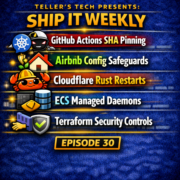
This episode of Ship It Weekly discusses crucial platform work that enhances system safety, including GitHub Actions hardening, Airbnb's safer config rollouts, and Cloudflare's zero-downtime Rust restarts.
For this episode, the thing that kept coming back was not really “security” on its own, or “platform” on its own, or even “reliability” on its own.
It was prevention.
More specifically, the kind of prevention that is easy to underfund because it does not make much noise when it works.
That is what tied these stories together for me.
The GitHub Actions story is probably the clearest example.
On the surface, pinning Actions to full commit SHAs sounds like one of those tiny details that only platform people care about. And honestly, that is exactly why it matters. The small boring details are where a lot of the real trust lives. The current GitHub direction makes that pretty plain. GitHub’s 2026 Actions security roadmap talks about dependency locking for workflows, centralized policy controls, better observability, and egress controls for runners, which is basically the platform saying out loud that CI is not a side layer anymore. It is part of the software supply chain and needs to be treated like it. (The GitHub Blog)
That fits really well with the way On Call Brief framed this week too. The W14 brief called out the Kubernetes-related policy shift toward full 40-character SHA pinning and made the operator takeaway very blunt: audit your workflows now, because the convenience model is getting tighter and the enforcement date is real. That is not just a repo hygiene story. That is trust moving from “good intentions” into actual controls.
And that is kind of the whole episode.
A lot of these stories are really about helper layers becoming real control surfaces.
Airbnb’s config story is another good example of that.
Config systems are funny because teams usually talk about them in one of two bad ways. Either they act like config should be totally flexible because speed matters, or they act like config is inherently dangerous so every change needs to feel like a mini change board. Airbnb’s Sitar platform is interesting because it is trying to escape that dumb tradeoff. The architecture gives teams staged rollouts, quick rollback, and local cached config so services can keep running off the last known good state even if the backend gets weird. That is such a practical, operator-minded design choice. The point is not just “make config dynamic.” The point is “make dynamic config survivable.” (Medium)
That is prevention work too.
And it is exactly the kind of work that often gets waved away because there is no giant launch event for “we made it easier to not take ourselves down with bad config.” But if you have ever lived through a config incident, you know how real that value is. There is a huge difference between moving fast and moving fast with rollback, staging, validation, and a sane failure mode.
Cloudflare’s graceful restart story hit the same nerve for me.
Again, on the surface, not glamorous. They open-sourced a Rust graceful restart library called ecdysis. Cool. But the actual point is that they have been using it in production for five years to do zero-downtime upgrades across critical Rust infrastructure, and they say it saves millions of requests on every restart. That is not cosmetic engineering. That is deeply practical reliability work. (The Cloudflare Blog)
And honestly, I love stories like that because they remind people what real platform maturity looks like.
Not just “can we build the thing.”
More like: can we restart the thing cleanly, can we patch the thing cleanly, can we keep handling real traffic while the thing changes, and can we do all that without turning normal admin work into customer pain.
That is grown-up infrastructure work.
Then the ECS Managed Daemons story keeps the same theme going, just from the AWS side.
AWS says ECS Managed Daemons lets teams centrally manage software agents like logging, tracing, security, and networking separately from application deployments, with exactly one daemon task per managed instance and a guarantee that daemons are running before app tasks are placed. That is the sort of thing platform teams have wanted for a long time. Separate the concerns. Let application rollout be application rollout. Let platform tooling be platform tooling. Stop making those two lifecycles trip over each other. (Amazon Web Services, Inc.)
And again, this is prevention.
It is making sure the cross-cutting operational stuff is present, consistent, and not at the mercy of whether an app team happened to coordinate the timing correctly. The better your platform gets, the more that kind of concern becomes explicit instead of improvised.
Same thing with the Terraform updates.
HashiCorp’s new IP allow list support is not flashy, but it is exactly the kind of control that matters. Tokens only being accepted from trusted IP ranges is simple, but simple is good when the alternative is “a valid token can theoretically be used from anywhere.” And the AWS permission delegation feature fits the same mold. Temporary, more explicit access instead of broad, standing permission that just kind of hangs around because it is easier. (HashiCorp | An IBM Company)
That is another version of this same lesson.
The good platform work is often about taking something that used to be loose and making it narrower on purpose.
And that connects really cleanly to the human side too.
Because one of the strongest lines in the current SRE Weekly issue is that enterprises often overfund failure and underfund prevention because failure is loud, prevention is quiet, and budgeting systems are wired to respond to noise. That line hit me because it explains a lot of what ops people feel all the time. The work that keeps people from getting paged is often the least visible work in the room. The outage gets the postmortem. The prevention work gets a shrug, if that. (SRE Weekly)
That is not just a budgeting problem. It is a human problem too.
Because the people who do this kind of work know how much it matters, but they also know how easy it is for organizations to miss it. If nothing breaks, leadership assumes everything is fine. If the rollout was quiet, the restart was clean, the daemon was there, the config stayed safe, and the token could not be abused from the wrong place, then it is easy for people outside the work to think none of that required much effort.
But of course it did.
That is the weird thing about ops.
The more effective the work is, the less visible it can feel.
And I think that is why this episode connected for me more than some louder batch of incident stories would have. This set of stories is really about how systems stay sane before the incident. The controls, rollout strategies, restart behavior, and access boundaries that keep normal change from turning into emergency change.
That is not glamorous.
It is also the job.
And the W14 On Call Brief had a good human framing around that too. It talked about the tension between the chaos we cannot predict and the chaos we choose for ourselves through maintenance, upgrades, and controlled disruption. That felt very on-brand for this episode. The art of this work is not just cleaning up after surprises. It is making sure the deliberate disruptions do not become accidental catastrophes. That is very close to the emotional center of ops, honestly.
So if I had to boil the whole episode down, I think it would be this:
A lot of the most important work in infrastructure is the work that keeps the background layers boring.
That is the work that lets teams move without paying for every change with stress, pages, or weird failure modes.
And maybe that is the human closer here too.
Not just that prevention is quiet.
But that quiet is hard-won.
It takes people noticing the weak spots before they become incidents. It takes people caring about the helper layers before leadership sees them as headline-worthy. It takes people doing the kind of work that rarely gets celebrated because, on the best days, nothing dramatic happens.
This episode of Ship It Weekly is about the quiet platform work that keeps things safe before they break. Brian covers GitHub Actions hardening in Kubernetes-related repos, Airbnb’s safer config rollouts, Cloudflare’s zero-downtime Rust restarts, Amazon ECS Managed Daemons, and HCP Terraform access controls with IP allow lists and temporary AWS permission delegation.





For this episode, the thing that kept coming back was not really “security” on its own, or “platform” on its own, or even “reliability” on its own.
It was prevention.
More specifically, the kind of prevention that is easy to underfund because it does not make much noise when it works.
That is what tied these stories together for me.
The GitHub Actions story is probably the clearest example.
On the surface, pinning Actions to full commit SHAs sounds like one of those tiny details that only platform people care about. And honestly, that is exactly why it matters. The small boring details are where a lot of the real trust lives. The current GitHub direction makes that pretty plain. GitHub’s 2026 Actions security roadmap talks about dependency locking for workflows, centralized policy controls, better observability, and egress controls for runners, which is basically the platform saying out loud that CI is not a side layer anymore. It is part of the software supply chain and needs to be treated like it. (The GitHub Blog)
That fits really well with the way On Call Brief framed this week too. The W14 brief called out the Kubernetes-related policy shift toward full 40-character SHA pinning and made the operator takeaway very blunt: audit your workflows now, because the convenience model is getting tighter and the enforcement date is real. That is not just a repo hygiene story. That is trust moving from “good intentions” into actual controls.
And that is kind of the whole episode.
A lot of these stories are really about helper layers becoming real control surfaces.
Airbnb’s config story is another good example of that.
Config systems are funny because teams usually talk about them in one of two bad ways. Either they act like config should be totally flexible because speed matters, or they act like config is inherently dangerous so every change needs to feel like a mini change board. Airbnb’s Sitar platform is interesting because it is trying to escape that dumb tradeoff. The architecture gives teams staged rollouts, quick rollback, and local cached config so services can keep running off the last known good state even if the backend gets weird. That is such a practical, operator-minded design choice. The point is not just “make config dynamic.” The point is “make dynamic config survivable.” (Medium)
That is prevention work too.
And it is exactly the kind of work that often gets waved away because there is no giant launch event for “we made it easier to not take ourselves down with bad config.” But if you have ever lived through a config incident, you know how real that value is. There is a huge difference between moving fast and moving fast with rollback, staging, validation, and a sane failure mode.
Cloudflare’s graceful restart story hit the same nerve for me.
Again, on the surface, not glamorous. They open-sourced a Rust graceful restart library called ecdysis. Cool. But the actual point is that they have been using it in production for five years to do zero-downtime upgrades across critical Rust infrastructure, and they say it saves millions of requests on every restart. That is not cosmetic engineering. That is deeply practical reliability work. (The Cloudflare Blog)
And honestly, I love stories like that because they remind people what real platform maturity looks like.
Not just “can we build the thing.”
More like:
can we restart the thing cleanly,
can we patch the thing cleanly,
can we keep handling real traffic while the thing changes,
and can we do all that without turning normal admin work into customer pain.
That is grown-up infrastructure work.
Then the ECS Managed Daemons story keeps the same theme going, just from the AWS side.
AWS says ECS Managed Daemons lets teams centrally manage software agents like logging, tracing, security, and networking separately from application deployments, with exactly one daemon task per managed instance and a guarantee that daemons are running before app tasks are placed. That is the sort of thing platform teams have wanted for a long time. Separate the concerns. Let application rollout be application rollout. Let platform tooling be platform tooling. Stop making those two lifecycles trip over each other. (Amazon Web Services, Inc.)
And again, this is prevention.
It is making sure the cross-cutting operational stuff is present, consistent, and not at the mercy of whether an app team happened to coordinate the timing correctly. The better your platform gets, the more that kind of concern becomes explicit instead of improvised.
Same thing with the Terraform updates.
HashiCorp’s new IP allow list support is not flashy, but it is exactly the kind of control that matters. Tokens only being accepted from trusted IP ranges is simple, but simple is good when the alternative is “a valid token can theoretically be used from anywhere.” And the AWS permission delegation feature fits the same mold. Temporary, more explicit access instead of broad, standing permission that just kind of hangs around because it is easier. (HashiCorp | An IBM Company)
That is another version of this same lesson.
The good platform work is often about taking something that used to be loose and making it narrower on purpose.
Narrower trust.
Narrower access.
Narrower blast radius.
Narrower assumptions.
And that connects really cleanly to the human side too.
Because one of the strongest lines in the current SRE Weekly issue is that enterprises often overfund failure and underfund prevention because failure is loud, prevention is quiet, and budgeting systems are wired to respond to noise. That line hit me because it explains a lot of what ops people feel all the time. The work that keeps people from getting paged is often the least visible work in the room. The outage gets the postmortem. The prevention work gets a shrug, if that. (SRE Weekly)
That is not just a budgeting problem. It is a human problem too.
Because the people who do this kind of work know how much it matters, but they also know how easy it is for organizations to miss it. If nothing breaks, leadership assumes everything is fine. If the rollout was quiet, the restart was clean, the daemon was there, the config stayed safe, and the token could not be abused from the wrong place, then it is easy for people outside the work to think none of that required much effort.
But of course it did.
That is the weird thing about ops.
The more effective the work is, the less visible it can feel.
And I think that is why this episode connected for me more than some louder batch of incident stories would have. This set of stories is really about how systems stay sane before the incident. The controls, rollout strategies, restart behavior, and access boundaries that keep normal change from turning into emergency change.
That is not glamorous.
It is also the job.
And the W14 On Call Brief had a good human framing around that too. It talked about the tension between the chaos we cannot predict and the chaos we choose for ourselves through maintenance, upgrades, and controlled disruption. That felt very on-brand for this episode. The art of this work is not just cleaning up after surprises. It is making sure the deliberate disruptions do not become accidental catastrophes. That is very close to the emotional center of ops, honestly.
So if I had to boil the whole episode down, I think it would be this:
A lot of the most important work in infrastructure is the work that keeps the background layers boring.
Boring workflows.
Boring config changes.
Boring restarts.
Boring agent coverage.
Boring token boundaries.
That is not small work.
That is the work that lets teams move without paying for every change with stress, pages, or weird failure modes.
And maybe that is the human closer here too.
Not just that prevention is quiet.
But that quiet is hard-won.
It takes people noticing the weak spots before they become incidents.
It takes people caring about the helper layers before leadership sees them as headline-worthy.
It takes people doing the kind of work that rarely gets celebrated because, on the best days, nothing dramatic happens.
That still counts.
Actually, that counts more than most things.
If you want the links behind the episode in one place, the episode was shaped heavily by On Call Brief Week 14 (https://www.tellerstech.com/on-call-brief-news/2026-W14/) , plus the GitHub Actions roadmap (The GitHub Blog), Airbnb’s config rollout write-up (Medium), Cloudflare’s graceful restart post (The Cloudflare Blog), Amazon ECS Managed Daemons (Amazon Web Services, Inc.), HashiCorp’s IP allow lists (HashiCorp | An IBM Company), AWS permission delegation for HCP Terraform (HashiCorp | An IBM Company), and the prevention framing from SRE Weekly (SRE Weekly).