Host Commentary
For this episode, the thing that kept showing up was not really “AI” by itself.
It was responsibility.
More specifically, what happens when companies roll out a new interface, a new abstraction, or a new “easy path,” and then quietly hand platform teams all the responsibility that comes with it.
That’s what tied these stories together for me.
McKinsey had to publicly deal with a vulnerability in Lilli, which is useful not because it turned into some huge apocalyptic breach story, but because it reminds people that internal AI tools are still real systems. They may look friendly. They may be framed like helpers. But once they can touch company knowledge, influence decisions, or sit in the middle of a workflow people trust, they stop being side tools. They become part of the operating surface.
And that means all the old questions come right back.
Who can access it.
What can it read.
What can it write.
What does it trust.
What gets logged.
What happens when somebody uses it in a way nobody really modeled.
That is the part people keep wanting to skip.
Everybody wants the new interface. Very few people want the old responsibilities that come with it.
The Kafka story hit a different version of the same theme.
Diskless topics are interesting because they feel like architecture honesty. Not hype. Not branding. Just a pretty direct acknowledgment that cloud economics eventually force you to revisit assumptions that used to feel settled. If durable local storage and broker-led replication were the obvious center of gravity before, maybe they are not the obvious center of gravity now. That is a much more useful kind of story to me than most “future of AI” noise, because it is really about something deeper: when the environment changes enough, old architecture starts charging rent.
And a lot of teams are probably living that right now, even outside Kafka.
You see it when the old design still technically works, but it works in a way that is more expensive, more awkward, or more fragile than anybody wants to admit. At some point, tuning stops being the answer. The answer becomes rethinking what the system is centered around in the first place.
Then there’s Google closing the Wiz acquisition, which to me reads less like a flashy M&A story and more like an admission about where the cloud fight actually is now.
The fight is not just compute. It is not just managed services. It is not just who has the nicest product page or the most polished launch event. It is posture. Visibility. Exposure. Identity. Policy. Security as part of the actual platform choice.
That feels obvious if you live in this space, but it is still worth saying out loud because companies still act like cloud strategy and security strategy are two separate conversations. I buy that less and less. Not when environments are this messy. Not when AI is adding new surfaces. Not when half the real work is figuring out what is running where, who can touch it, and what your blast radius looks like when somebody gets it wrong.
The AWS Copilot story is kind of the same lesson again, just in a more familiar cloud-ops form.
The paved road moved.
That’s really the story.
And platform teams know exactly what that means. It means the thing that felt like the safe, vendor-approved path now has an off-ramp. It means migration work. Retraining. Documentation churn. Re-explaining choices to teams that thought the answer was already settled. It means carrying the cost of somebody else’s product direction.
That is why I keep coming back to the idea that convenience in cloud is borrowed.
Sometimes borrowing it is absolutely worth it. I am not against paved roads. Most teams should probably use more of them, not less. But the tradeoff is always there. When the road changes, you move too. And if you have not thought about the exit story in advance, the migration always feels more annoying than it should.
Then the Kubernetes AI Gateway Working Group rounds the whole episode out in a way I really like, because it cuts through a lot of the dumbest AI discourse.
The interesting question is not “do you believe in AI” or “what model is best this week.”
The interesting question is what happens when AI traffic becomes normal platform traffic.
Because once that happens, the conversation gets a lot more real. Now it is rate limiting. Access control. Payload inspection. Egress policy. Caching. Guardrails. Prompt injection defenses. Logging. Routing. Normal boring platform words. Which is exactly why I like the story. It is a sign that the industry is moving from novelty into operations.
And that is usually where the truth shows up.
If I had to boil the whole episode down, I think it comes back to this:
The new interface does not remove the old responsibilities.
That is true for internal AI tools.
It is true for cloud architecture.
It is true for security acquisitions.
It is true for vendor paved roads.
And it is definitely true for AI-shaped traffic once it starts touching real systems.
There’s always a shiny version of the story companies want to tell.
Smarter tools.
Faster delivery.
Simpler workflows.
Better leverage.
A more intelligent future.
And sure, some of that is real.
But the operator version of the story always lands a little differently.
What are the trust boundaries.
What gets logged.
What is actually enforced.
How clean is rollback.
What happens when the vendor changes direction.
What assumptions are now too expensive to keep pretending are normal.
Who owns the control plane after all this stuff hardens into real production dependency.
That’s where this episode lived for me.
Not in the hype.
Not in the demo.
Not in whether the new thing sounds cool.
More in the handoff point where new capability turns into somebody else’s operational burden.
And most of the time, that somebody is us.
Show Notes
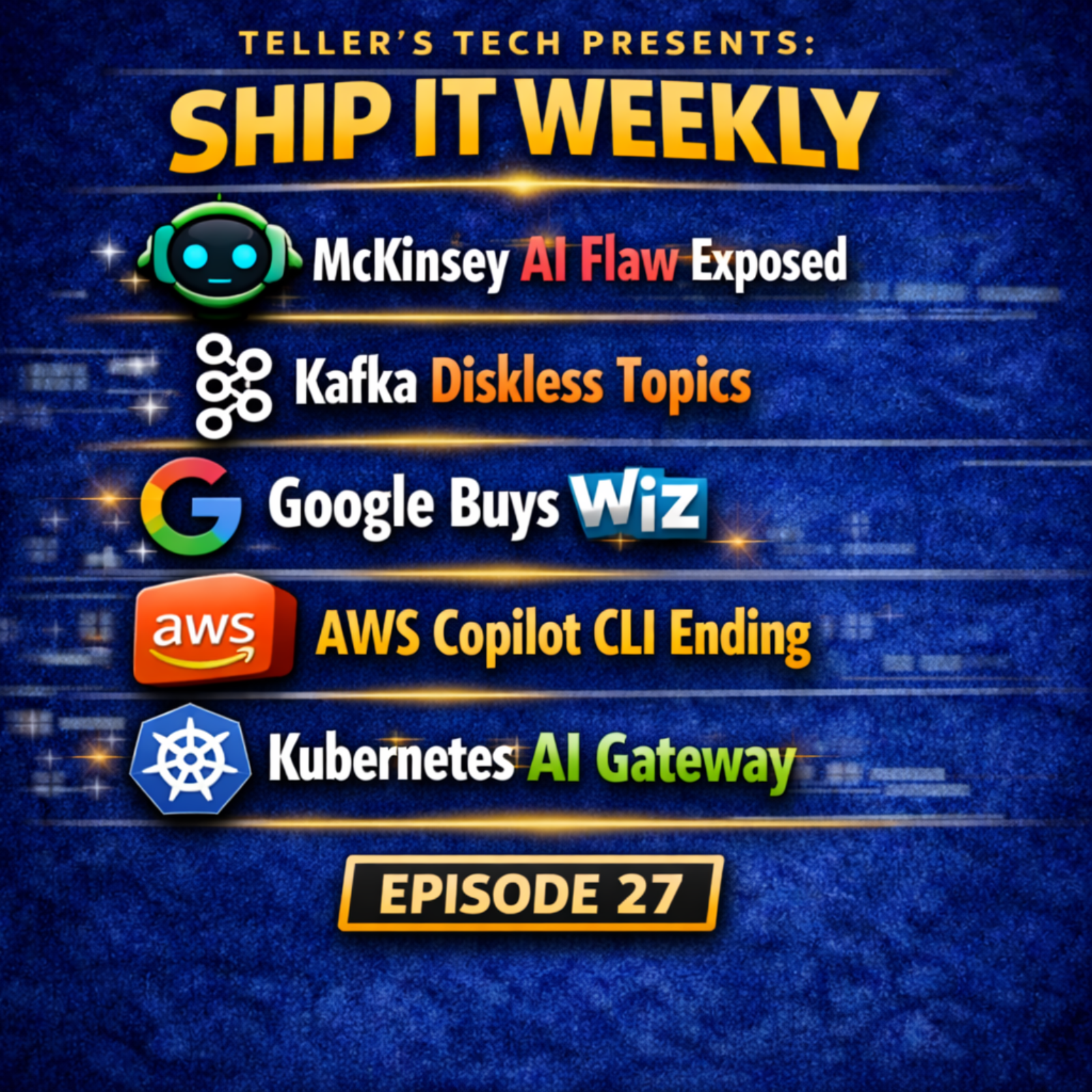
This week on Ship It Weekly, Brian looks at what happens when new interfaces create old responsibilities.
McKinsey patched a vulnerability in its internal AI tool Lilli, Kafka contributors are pushing a diskless-topics model that rethinks durability and replication in cloud environments, and Google officially closed Wiz acquisition in one of the biggest cloud-security moves. Plus: AWS is sunsetting Copilot CLI, Kubernetes launches an AI Gateway Working Group.
Links
McKinsey statement on Lilli
https://www.mckinsey.com/about-us/media/statement-on-strengthening-safeguards-within-the-lilli-tool
Kafka diskless topics proposal
Google completes acquisition of Wiz
https://blog.google/innovation-and-ai/infrastructure-and-cloud/google-cloud/wiz-acquisition/
AWS Copilot CLI end-of-support
https://aws.amazon.com/blogs/containers/announcing-the-end-of-support-for-the-aws-copilot-cli/
Kubernetes AI Gateway Working Group
https://kubernetes.io/blog/2026/03/09/announcing-ai-gateway-wg/
Amazon Bedrock observability for first-token latency and quota consumption
https://aws.amazon.com/about-aws/whats-new/2026/03/amazon-bedrock-observability-ttft-quota/
Cloudflare JSON responses and RFC 9457 support for 1xxx errors
https://developers.cloudflare.com/changelog/post/2026-03-11-json-rfc9457-responses-for-1xxx-errors/
Amazon S3 source-region information in server access logs
https://aws.amazon.com/about-aws/whats-new/2026/02/amazon-s3-source-region-information/
AWS Config adds 30 new resource types
https://aws.amazon.com/about-aws/whats-new/2026/03/aws-config-new-resource-types/
Amazon Bedrock AgentCore Runtime stateful MCP server features
https://aws.amazon.com/about-aws/whats-new/2026/03/amazon-bedrock-agentcore-runtime-stateful-mcp/
More episodes and show notes at
On Call Briefs at