0:00
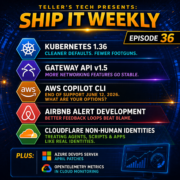
You know that moment when a platform stops sounding
0:02
helpful and starts sounding serious? That's this
0:05
week. Kubernetes is cleaning house. Gateway API
0:08
keeps getting more official. AWS is moving on
0:11
from Copilot. Airbnb is showing why production
0:14
should not be your first alert test. And Cloudflare
0:18
is reminding everybody that a bot with a token
0:21
is still a principal with blast radius. Hey,
0:41
I'm Brian Teller. I work in DevOps and SRE and
0:44
I run Teller's Tech. This is Ship It Weekly,
0:47
where I filter the noise and focus on what actually
0:50
changes how we run infrastructure and own reliability.
0:53
Show notes and links are on shipitweekly .fm.
0:57
If the show's been useful, follow it wherever
0:59
you listen. Ratings help way more than they should.
1:02
We have five main stories today, then the lightning
1:05
round, and we'll wrap with the human closer.
1:07
We're starting with Kubernetes 1 .36 because
1:10
this feels like one of those releases where the
1:13
project keeps sanding off older sharp edges while
1:16
pushing more production grade features into stable
1:19
territory. Then Gateway API version 1 .5, which
1:24
is basically SIG network saying the future is
1:27
not just coming. It is getting promoted into
1:29
the stable path now. After that, AWS Copilot
1:32
CLI end of support because this is a very real
1:36
platform story. One easy path is aging out and
1:40
AWS is pretty clearly nudging people towards
1:42
the next preferred path. Then we've got Airbnb
1:45
on alert development, which is probably my favorite
1:49
SRE story in the set because it is really about
1:52
how better feedback loops beat blaming culture.
1:55
And finally, Cloudflare on non -human identities.
1:59
Because this is one of the clearest examples
2:01
lately of security vendors saying out loud that
2:04
scripts, agents, and third -party tools need
2:08
to be treated like first -class identities, not
2:10
side characters. Story 1. Kubernetes 1 .36 feels
2:19
like a maturity release. Let's start there. Kubernetes
2:22
1 .36 shipped on April 22nd. The release includes
2:27
70 enhancements with 18 graduating to stable,
2:31
25 entering beta, and 25 moving to alpha. That
2:35
alone gives you the usual big release energy,
2:38
but the more interesting part is what it says
2:41
about where the project is spending its maturity
2:44
budget. One of the clearest examples is service
2:46
.spec. external IPs. Kubernetes says that field
2:51
is now deprecated, calls it as a known security
2:54
headache, and points back to the long -running
2:57
man -in -the -middle risk around CVE -2020 -8554.
3:02
You'll see warnings now, and full removal is
3:05
planned for version 1 .43. Kubernetes is also
3:09
permanently disabling the old Git repo volume
3:12
plugin in 1 .36, saying that path is closed for
3:17
good and existing workloads need to move to alternates
3:21
like init containers or external Git sync style
3:24
tools. That's why I like this story, because
3:27
this is not just look at all of the new stuff.
3:30
It is Kubernetes continuing to act like a platform
3:33
that wants fewer half -legacy foot guns hanging
3:37
around forever. And honestly, that is what maturity
3:40
often looks like. Not more knobs, fewer weird
3:43
things everybody knows are sketchy, but keeps
3:46
tolerating anyway. And there's another angle
3:49
here that makes this release feel more grown
3:51
up than flashy. Kubernetes 1 .36 is also pushing
3:55
more of the supply chain and packaging story
3:58
towards cleaner primitives. The release highlights
4:01
support for packaging read -only application
4:04
data. models, and static assets as OCI artifacts
4:08
and delivering them to pods through the same
4:11
registries and versioning workflows teams already
4:15
use for container images. It also calls out staleness
4:18
migration work for controllers, which matters
4:21
because a lot of weird controller behavior does
4:24
not show up as a dramatic crash. It shows up
4:27
as a controller acting on stale assumptions at
4:30
the wrong time and doing the wrong thing very
4:33
confidently. So the practical read for me is
4:36
this. If you run Kubernetes at any real scale,
4:39
1 .36 is the kind of release where you should
4:42
not just skim the release nodes for what's new.
4:45
You should skim them for what old thing are they
4:48
finally done tolerating? And what newer path
4:51
is now stable enough that we should stop calling
4:54
it experimental in our own heads? Because that's
4:57
usually where the real platform signal is. Story
5:04
2, Gateway API version 1 .5, is the networking
5:08
future getting more real. Next up, Gateway API.
5:11
SIG Network announced Gateway API version 1 .5
5:15
on April 21st, called it the biggest release
5:18
yet, and said the focus was moving existing experimental
5:21
features into the standard, meaning stable, channel.
5:25
The release promotes six features that people
5:27
actually care about. Listener set, TLS route,
5:31
HTTP route, CORS Filter, Client Certificate
5:35
Validation, Certificate Selection for Gateway
5:37
TLS Origination, and Reference Grant. They also
5:41
moved to a release train model, which basically
5:44
means features ship when they are ready at freeze
5:47
time instead of waiting for some perfect bundle.
5:50
That matters because Gateway API is no longer
5:53
just a nice future -facing idea for people who
5:56
like cleaner abstractions. It keeps becoming
5:58
the actual road forward. Especially now that
6:01
Kubernetes itself is pointing people towards
6:04
gateway API in places where older patterns are
6:07
being deprecated. And especially after all of
6:10
the broader ingress and controller retirement
6:12
pressure we've already been seeing this year.
6:15
So to me, the real read here is simple. The networking
6:18
control plane in Kubernetes keeps getting more
6:22
explicit, more standardized, and less willing
6:25
to leave everything. in the controller specific
6:27
magic plus annotations bucket forever. And some
6:31
of the specific gateway API promotions are worth
6:34
slowing down on for a second. Listener set is
6:37
interesting because it gives teams a cleaner
6:39
way to contribute listeners to a gateway without
6:43
forcing everything into one giant resource owned
6:46
by one team. TLS route going stable matters because
6:50
it makes the TLS pass through and terminate use
6:53
cases feel more first class. The CORS filter
6:56
moving into the standard channel is also one
6:59
of those small looking things that matters a
7:02
lot in real life because it is exactly the kind
7:05
of behavior people used to bury in controller
7:08
specific config or app side workarounds. And
7:11
the move to a release train model is its own
7:14
kind of maturity signal too. It means the project
7:16
is optimizing less for perfect bundling and more
7:20
for predictable forward motion. So if I'm a platform
7:23
team, the takeaway is not just cool, more gateway
7:26
API stuff. It is probably how much of our ingress
7:30
and edge behavior is still trapped in annotations.
7:33
How much of it is controller specific and how
7:35
much of it now has a cleaner upstream shaped
7:38
home we should actually plan forward. Story three,
7:45
AWS Copilot is reaching end of support. And
7:49
that tells you a lot. Now to AWS. AWS says Copilot
7:53
CLI reaches end of support on June 12th, 2026.
7:58
It will remain available as an open source project
8:01
on GitHub. But AWS says it will no longer receive
8:04
new features or security updates from AWS. In
8:08
the same announcement, AWS points users towards
8:11
Amazon ECS Express Mode and AWS CDK Layer 3 constructs
8:16
as the migration paths they want people evaluating.
8:19
This is one of those stories I like because it
8:21
is not really about the tool alone. It is about
8:24
the platform preference. Copilot was AWS's opinionated
8:28
developer -friendly path for developing containerized
8:31
apps on ECS and AppRunner. Now AWS is pretty
8:35
clearly saying the newer opinionated paths are
8:39
somewhere else. That does not mean Copilot users
8:41
did anything wrong. It just means the center
8:44
of gravity moved. And that is a very real cloud
8:47
platform lesson. Sometimes the easy path you
8:50
picked was genuinely the right call at the time.
8:53
Then the provider evolves. The preferred abstractions
8:56
change. And now your job is not debating whether
8:59
the shift is fair. Your job is planning the migration
9:02
before the old path becomes operational debt
9:06
with a calendar attached to it. And there is a
9:09
migration planning lesson here that I think gets
9:12
missed when people hear end of support. Copilot
9:15
did a lot more than just offer a nicer CLI. AWS
9:19
says it used CloudFormation stacks for the app
9:22
and service layers, which means a lot of teams
9:24
probably have more Copilot -shaped infrastructure
9:27
under the hood than they remember. So the right
9:31
response here is not panic. It is inventory.
9:34
What workloads are still on Copilot? Which ones
9:37
are app runner versus ECS? Which parts of the
9:41
deployment flow are tied to Copilot convention?
9:44
And whether the real destination should be express
9:47
mode for simplicity or CDK L3 constructs for
9:51
teams that want stronger IAC controls and customization.
9:55
AWS is pretty explicit. that Express Mode is
9:59
meant to preserve a lot of the simplicity that
10:02
made Copilot attractive, while CDK L3 is the
10:06
more customizable path. That is the kind of thing
10:08
I would actually say out loud to a team. Do not
10:11
turn this into a philosophical debate about whether
10:14
Copilot was good. Assume it was good for when
10:17
you picked it. Now ask, what will be annoying
10:20
to unwind later if you ignore the date now? Story
10:27
4. Airbnb says alert pain was a workflow problem,
10:31
not a culture problem. This one is probably my
10:34
favorite in the whole episode. Airbnb says the
10:37
issue with alert development was not that engineers
10:41
did not care. It was that their observability
10:43
as code workflow had a blind spot. Code review
10:47
could validate syntax and logic, but not actual
10:50
alert behavior against real -world data. So production
10:54
kept becoming the proving ground. Airbnb says
10:57
they built fast feedback loops to preview, validate,
11:01
and surface alert behavior before PR submission,
11:05
cut development cycles from weeks to minutes,
11:07
and used the workflow to help migrate 300 ,000
11:11
alerts from a vendor to Prometheus. They also
11:14
say what used to take a month of iteration can
11:17
now take an afternoon. This is such a good SRE
11:20
story. Because it is very easy to look at noisy
11:24
alerts, weak alerts, or slow alert iteration
11:26
and say, this is just a culture problem, or people
11:30
just need to care more. Sometimes, sure. But
11:33
a lot of the time, the workflow is just bad.
11:35
If the only way to see whether an alert behaves
11:38
correctly is to merge it and wait, then you built
11:41
a system where production is the testing harness
11:44
and on -call is the feedback loop. That is not
11:47
a motivation issue. That is a tooling issue.
11:50
And Airbnb's fix is basically the kind of thing
11:53
platform teams should love. Earlier feedback,
11:56
more confidence inside the PR, less wasted iteration
12:00
after the fact. And Airbnb made another design
12:03
choice here that I really liked. They explicitly
12:06
chose compatibility over novelty. Instead of
12:09
inventing some exotic, proprietary, alert analyst
12:13
model, they took Prometheus role groups as the
12:17
input. used Prometheus's own rule evaluation
12:19
engine, and wrote the results back out as Prometheus
12:23
time series blocks, exposed through the standard
12:26
query API. That is a really smart platform move
12:29
because it means the preview and analysis system
12:32
fits into the workflows engineers already understand.
12:36
Instead of becoming one more internal snowflake,
12:39
everybody has to relearn. That matters because
12:42
a lot of internal platform tooling dies, not
12:45
because the idea was bad. but because the workflow
12:47
becomes learn our special thing first. Airbnb's
12:51
version sounds more like use the standards, use
12:54
the real engine, show people the delta before
12:56
they merge, and make the right thing easier than
12:59
the lazy thing. That is honestly a great pattern
13:02
well beyond alerting. Story five. Cloudflare
13:09
is saying non -human identity is now the real
13:13
identity story. Last main story. Last time in
13:16
episode 34, Cloudflare was talking about the
13:19
network fabric for agents. This time, they're
13:22
talking about the identity, token, and permission
13:25
model around them. Cloudflare's framing here
13:27
is very direct. Identities are not just people
13:30
anymore. They are agents, scripts, and third -party
13:33
tools acting on your behalf. Their update packages
13:37
that into three practical areas. scannable API
13:40
tokens, better OAuth visibility and revocation,
13:43
and more granular resource -scoped RBAC. Cloudflare
13:47
says new tokens are easier for scanners to recognize.
13:50
Customers now get a central connected applications
13:53
experience for OAuth access and revocation. And
13:57
resource -scoped permissions are available for
14:00
more resources so both users and agents can be
14:03
right -sized more tightly. They also say these
14:06
scopes can be assigned through the dashboard,
14:09
the API, or Terraform. And I think that this
14:12
story matters because it is one of the clearer
14:15
examples of the industry dropping the pretense.
14:18
An agent with a token is not some cute helper.
14:21
It is an identity with power. A script with standing
14:24
access is not background noise. It is an identity
14:28
with power. A third -party OAuth app is not just
14:32
a convenience. It is an identity with power.
14:35
And once you accept that, the rest of the story
14:38
gets more normal. Token scanning, connected app
14:41
visibility, permission scoping, leased privilege.
14:45
This is just IAM growing up around modern workloads
14:48
and agent -heavy environments. And I also like
14:51
that Cloudflare is not treating this as some
14:54
abstract future of security thing. The token
14:57
changes are practical. They added a recognizable
15:00
prefix and checksum so scanners can identify
15:04
Cloudflare tokens with much higher confidence.
15:08
The OAuth work is practical too. You can review
15:11
the app name. publisher, requested scopes, and
15:14
which accounts the app is asking to access before
15:18
you approve it, and then see those connected
15:20
applications later in one place to revoke them
15:24
if needed. And their resource scoped permissions
15:27
framing is probably the most useful mental model
15:30
in the whole post. The token gets you in the
15:32
building. But scopes should decide which rooms
15:35
you can enter. That is the part I think teams
15:37
should take seriously. If you are letting agents,
15:40
scripts, and third -party automations pile up
15:43
with broadstanding access, you do not really
15:46
have an AI governance problem. You have an IAM
15:49
hygiene problem that got new branding. Okay,
15:59
a few quick ones before we wrap. Microsoft shipped
16:02
April patches for Azure DevOps Server and says
16:06
they strongly recommend staying on the latest
16:09
secure version. The patch fixes a null reference
16:12
issue that could break pull request completion
16:15
during work item auto -completion, improves sign
16:18
-out validation to prevent potential malicious
16:21
redirects, and fixes PAT connection creation
16:24
for GitHub Enterprise Server. That is a very
16:28
practical PatchNow item. Google also pushed more
16:31
on OTLP metrics for cloud monitoring. Google
16:35
says you can send metrics to cloud monitoring
16:37
through a provider -agnostic OpenTelemetry pipeline,
16:41
store that data in the same format as managed
16:44
service for Prometheus, and query it through
16:47
the same cloud monitoring interfaces. That is
16:49
a nice observability standard story because it
16:52
is not just support the protocol. It is make
16:55
the protocol path actually first class. I think
17:06
the human thread underneath this week's episode
17:08
is that a lot of engineering pain comes from
17:11
waiting too long to make responsibilities explicit.
17:14
Kubernetes is making some of that explicit by
17:17
deprecating or removing paths it clearly does
17:20
not want to keep carrying forever. Gateway API
17:23
is making networking intent more explicit. AWS
17:27
is making platform preference more explicit by
17:30
telling people where Copilot stops and where
17:33
the next preferred paths begin. Airbnb is making
17:36
alert quality less dependent on vague craftsmanship
17:40
and more dependent on visible feedback before
17:43
merge. And Cloudflare is making it harder to
17:46
pretend that agents and scripts are somehow outside
17:49
the normal identity and access conversation.
17:52
And this is where I think platform work gets
17:54
misunderstood sometimes. People talk about maturity
17:57
like it means more automation, more abstraction,
18:00
more paved roads. Sometimes it does. But just
18:03
as often, maturity is really about being honest
18:06
sooner. Honest about which patterns are legacy.
18:09
Honest about which workflows are broken. Honest
18:12
about which tools are losing support. Honest
18:15
about whether production is secretly your only
18:17
validation environment. Honest about who or what
18:21
actually has access in your environment. That
18:24
is not as fun as a big shiny launch. But it is
18:27
usually where a lot of the real risk reduction
18:30
comes from. Because the longer a team stays fuzzy
18:33
on ownership, the more that fuzziness turns into
18:37
toil. And the more that toil turns into staffing
18:40
pain. And the more that that staffing pain turns
18:43
into reliability pain. Not because anybody is
18:46
lazy. Not because people do not care. Usually
18:49
just because too many systems stayed ambiguous
18:52
for too long. So yeah, that's probably my biggest
18:57
takeaway from this week. Better platforms do
18:59
not just make things easier. They make certain
19:02
kinds of vagueness harder to sustain. And honestly,
19:05
that is usually a good thing. All right. That's
19:08
it for this episode of Ship It Weekly. Quick
19:11
recap. Kubernetes 1 .36 and why it feels like
19:15
a maturity release. Gateway API version 1 .5
19:18
moving more core networking features into stable
19:21
territory. AWS Copilot reaching end of support
19:25
and what that says about shifting preferred paths.
19:28
Airbnb proving alert pain was a workflow gap.
19:32
not just a cultural issue. And Cloudflare making
19:35
the case that non -human identity is now a core
19:38
security story. Then in the lightning round,
19:41
Azure DevOps server patches and Google Cloud
19:44
OTLP metric support. Links and show notes are
19:48
on shipitweekly .fm. You can also find video
19:51
versions on YouTube. If this episode was useful,
19:54
follow or subscribe wherever you listen and send
19:57
it to the person on your team. who keeps having
19:59
to explain that reliability problems are usually
20:02
workflow problems long before they became on
20:05
-call problems. I'm Brian, and I'll see you next
20:08
week.