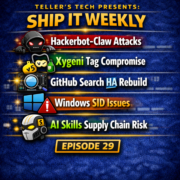
Host Commentary
For this episode, the thing that kept showing up was not really “security” in the narrow sense.
It was trust.
More specifically, what teams keep treating like convenience right up until it turns out to be part of the control plane.
That’s what tied these stories together for me.
The Trivy follow-up is the clearest example.
We already touched this in Episode 24, when the Trivy incident still looked like one ugly GitHub Actions compromise in a very exposed repo. But the reason it was worth coming back to now is that the bigger hackerbot-claw campaign makes the whole thing feel less like a one-off and more like a real pattern. The OpenSSF advisory described active exploitation in the wild, with attacker focus on weak GitHub Actions configurations like pull_request_target, untrusted code execution from forks, inline shell, and missing authorization checks before workflows run. (SecLists)
That matters because it is one more reminder that CI is not “just internal tooling.”
It’s a trust boundary.
If a workflow can publish artifacts, write to the repo, touch secrets, or push code, then it is not background glue. It is a production-adjacent system with real blast radius. And I think a lot of teams still know that intellectually, but do not really operate like they believe it.
That’s why I liked revisiting the Trivy story this way.
Not to do the same episode twice.
More to show that the original incident was part of a broader shift. Attackers are not waiting around for app-layer bugs if the release path itself is softer and more reachable. That’s a more interesting story than “AI bot attacks repo,” even if the flashier headline gets more clicks. (SecLists)
Then Xygeni comes in and pushes the same lesson from another angle.
StepSecurity’s write-up says the official xygeni-action was compromised on March 3 through stolen maintainer credentials and a compromised GitHub App token, and that the attacker moved the mutable v5 tag to a malicious commit. The important part there is that downstream repos using @v5 did not need a YAML change to become exposed. The trust moved underneath them. (StepSecurity)
That’s the part I think platform teams should sit with.
We talk about mutable tags like they are some minor implementation detail. They’re not. They’re a trust decision. If your workflow points at something that can move, then your trust is attached to the controls around that movement, not to the nice short version string in your file.
That’s a very different way to think about it.
And honestly, that feels like the deeper theme of the whole episode. A lot of things that look stable are really only stable because you have not yet watched the trust model underneath them shift.
The GitHub Enterprise Server search story hit the same theme too, just without the security framing.
GitHub said it rebuilt search high availability in GHES because the old Elasticsearch layout could leave customers in bad maintenance states, and the new design moves to single-node clusters with Cross Cluster Replication. That story is useful because it is what architecture honesty looks like. The old shape kept creating operational pain, so they changed the shape. (The GitHub Blog)
I like stories like that because they feel real.
Not “look at this shiny launch.”
More like, this thing kind of worked until normal operations exposed that it was harder to manage safely than it should have been.
And I think a lot of teams have one or two systems like that right now. Stuff that technically works, but only if maintenance is careful, failover is polite, and nobody breathes on it too hard. At some point, the mature move is not another runbook note. It is admitting the design itself is now the operational burden.
Then the Windows Server 2025 story fits the same pattern in a way that is almost annoyingly familiar.
Microsoft says nongeneralized Windows Server 2025 images can break Exchange functionality after KB5065426 because the update introduces strict duplicate SID checks, exposing issues caused by reused images, clones, or snapshots that were never properly generalized with Sysprep. (Microsoft Learn)
That is such a classic ops reality.
The shortcut works for a long time.
Nobody wants to go back and clean it up.
Then the platform hardens one layer of identity behavior and suddenly an old image habit becomes a real incident.
That is why I wanted that story in the episode even though it is less flashy than the GitHub ones. It is a really clean example of how security hardening often works in practice. It does not just improve the system. It exposes the old places where teams were getting away with things.
And that brings me to the last story, which honestly might be the most forward-looking one in the bunch.
Socket says skills.sh had already indexed more than 60,000 skills in February and that anyone can publish a skill from any GitHub repository. Snyk then scanned 3,984 skills from ClawHub and skills.sh and said 13.4% had at least one critical issue, 36.82% had at least one security flaw of any severity, and 76 malicious payloads were confirmed through human review. Both write-ups frame this as the old package ecosystem problem coming back in a new form, except now the installed thing may inherit shell access, files, APIs, credentials, or memory through the agent using it. (Socket)
And that, to me, is where the episode really lands.
Because this is not just “AI security” in the trendy sense.
It is the same old trust problem coming back in systems that feel lighter, faster, and more casual than they really are.
A workflow is not just automation.
A tag is not just a shortcut.
A VM image is not just a clone.
A skill is not just a prompt add-on.
A directory is not just discovery.
The minute any of those things can change outcomes, inherit permissions, or move trust around, they stop being helpers. They become part of the operating surface.
That is the real operator version of the story.
And I think that is why this episode connected for me more than a generic “supply chain bad” week would have.
Every one of these stories is really about the same handoff point.
The point where convenience quietly becomes trust.
The point where something easy becomes something you are relying on.
The point where the nice abstraction stops being neutral and starts carrying security, reliability, or availability consequences.
The point where a team realizes too late that a helper tool has become part of the control plane.
That is where the work lives now.
Not in the abstract.
Not in the marketing.
Not in “should we use AI” or “should we automate more.”
More in the very boring questions that always matter once a system gets real.
What is mutable.
Who can change it.
What permissions does it inherit.
What assumptions are baked in.
What does normal failure look like.
What old shortcut is one platform update away from becoming your next outage.
That’s where this episode lived for me.
Not really in the attacks themselves.
More in the fact that so much modern infra is now built on layers people still talk about like they are optional, lightweight, or “just there to help.”
They’re not.
A lot of them are now part of the trust boundary.
And if teams do not start treating them that way, attackers, outages, and platform changes are going to keep teaching the lesson for them.
Past Ship It Weekly references
Episode 24, where we first talked about the Trivy incident as part of the earlier hackerbot-claw wave. 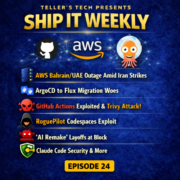 AWS Bahrain/UAE Data Center Issues Amid Iran Strikes, ArgoCD vs Flux GitOps Failures, GitHub Actions Hackerbot-Claw Attacks (Trivy), RoguePilot Codespaces Prompt Injection, Block “AI Remake” Layoffs, Claude Code SecurityEpisode: AWS Bahrain/UAE Data Center Issues Amid Iran Strikes, ArgoCD vs Flux GitOps Failures, GitHub Actions Hackerbot-Claw Attacks (Trivy), RoguePilot Codespaces Prompt Injection, Block “AI Remake” Layoffs, Claude Code Security
Episode 20, the OpenClaw special, because the AI skills story in this episode feels like the same broader control-plane problem showing up in another form. 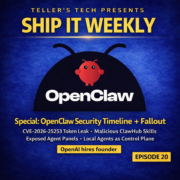 Special: OpenClaw Security Timeline and Fallout: CVE-2026-25253 One-Click Token Leak, Malicious ClawHub Skills, Exposed Agent Control Panels, and Why Local AI Agents Are a New DevOps/SRE Control Plane (OpenAI Hires Founder)Episode: Special: OpenClaw Security Timeline and Fallout: CVE-2026-25253 One-Click Token Leak, Malicious ClawHub Skills, Exposed Agent Control Panels, and Why Local AI Agents Are a New DevOps/SRE Control Plane (OpenAI Hires Founder)
Episode 21, on defaults shifting under ops teams, because this week really is another version of that same pattern. 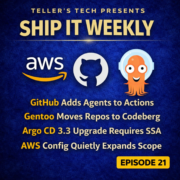 GitHub Agentic Workflows, Gentoo Leaves GitHub, Argo CD 3.3 Upgrade Gotcha, AWS Config Scope CreepEpisode: GitHub Agentic Workflows, Gentoo Leaves GitHub, Argo CD 3.3 Upgrade Gotcha, AWS Config Scope Creep
Source links mentioned
OpenSSF advisory on active exploitation of weak GitHub Actions configurations. (SecLists)
StepSecurity on the Xygeni action compromise via tag poisoning. (StepSecurity)
GitHub on rebuilding search high availability in GitHub Enterprise Server. (The GitHub Blog)
Microsoft on duplicate SIDs and nongeneralized Windows Server 2025 images. (Microsoft Learn)
Socket on supply chain security for skills.sh. (Socket)
Snyk ToxicSkills research on agent skills risk. (Snyk)
Show Notes
This episode of Ship It Weekly is about the places where convenience quietly turns into trust.
Brian revisits the Trivy story by zooming out to the bigger hackerbot-claw GitHub Actions campaign, then gets into the Xygeni tag-poisoning compromise, GitHub’s search high availability rebuild for GitHub Enterprise Server, Windows Server 2025 surfacing duplicate SID problems in cloned images, and the agent-skills ecosystem replaying package supply chain history. Plus: a quick lightning round on GitHub pausing self-hosted runner minimum-version enforcement and March secret scanning updates.
Links
OpenSSF advisory on active GitHub Actions exploitation https://seclists.org/oss-sec/2026/q1/246
Xygeni action compromise via tag poisoning https://www.stepsecurity.io/blog/xygeni-action-compromised-c2-reverse-shell-backdoor-injected-via-tag-poisoning
GitHub Enterprise Server search high availability rebuild https://github.blog/engineering/architecture-optimization/how-we-rebuilt-the-search-architecture-for-high-availability-in-github-enterprise-server/
Microsoft on duplicate SIDs and nongeneralized Windows Server 2025 images https://learn.microsoft.com/en-us/troubleshoot/exchange/administration/exchange-server-issues-on-incorrect-windows-server-image
Socket on supply chain security for skills.sh https://socket.dev/blog/socket-brings-supply-chain-security-to-skills
Snyk ToxicSkills research https://snyk.io/blog/toxicskills-malicious-ai-agent-skills-clawhub/
GitHub self-hosted runner minimum version enforcement paused https://github.blog/changelog/2026-03-13-self-hosted-runner-minimum-version-enforcement-paused/
GitHub secret scanning pattern updates, March 2026 https://github.blog/changelog/2026-03-10-secret-scanning-pattern-updates-march-2026/
More episodes and show notes at https://shipitweekly.fm
On Call Briefs at https://oncallbrief.com